


What to Write in a Sympathy Card When You Don’t Know What to Say
Aug 22, 2026
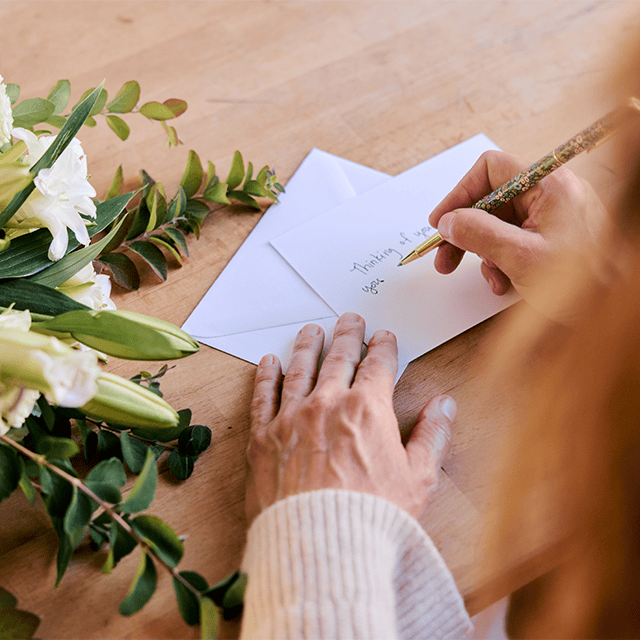
If you landed here because you searched what to write in a sympathy card, I’m guessing there’s a pretty good chance you have a blank card sitting in front of you right now and absolutely no idea what to put in it. You’re not doing this wrong, I promise. It happens to all of us. Sympathy cards are SO hard because the thing you’re trying to acknowledge is so much bigger than anything you could possibly fit on that little piece of paper. Someone has lost a person they love, and meanwhile you’re sitting there wondering whether saying something like “thinking of you” sounds completely generic, or whether “I’m sorry for your loss” is even close to enough. And you know it isn’t, because how could it be?
We all put an enormous amount of pressure on ourselves to find exactly the right words when someone dies, as if there is some magical sentence out there that will make their grief even slightly less terrible. And I wish I could tell you that after reading thousands of sympathy cards sent with flowers, I found that one group of words that takes away the greatest of pains. But there just isn’t. And I’ve come to realize that accepting that makes writing a sympathy card a tiny bit easier. It at least allows you to know that you are not responsible for taking away their grief or making sense of what happened — even though you’d give your right arm if you could.
The very best thing that is in your power to do is really just to show up and remind them that they are loved and that someone else sees what they’re going through. That’s a big job, and it’s a real privilege too.
What Should You Write in a Sympathy Card?
My biggest advice is to stop trying to sound like a sympathy card and just sound like yourself. If you would never look your best friend in the eye and say, “Please accept my deepest condolences during this difficult time,” then you probably don’t need to suddenly start talking that way. Saying something much simpler and much more real goes much further to reaching them where they are.
You can write, “I’m so incredibly sorry. I wish there were something I could say to make this even a little bit easier, but I know there isn’t. I love you and I’m here.” Or, “There really aren’t words for this. So just know that I’m thinking about you and your family and sending you so much love.” Or even, “I don’t know what to say. I just know I love you and I’m so sorry.” Honestly, that last one is beautiful because it’s the absolute truth.
You don’t need to fill the space — figuratively or literally. And you don’t need to find a quote or somehow become a poet to try and make them feel better. A heartfelt sympathy message that sounds like you will almost always mean more than something more eloquent that doesn’t.
How Do You Sign a Sympathy Card?
Sign it the way you would actually say goodbye to this person. That’s the whole answer, and I mean it. “Love,” or “All my love,” for the people closest to you. “With love and sympathy,” or “Thinking of you,” for someone you know warmly. “With deepest sympathy,” or even “Sincerely,” for a coworker or an acquaintance — and yes, “Sincerely” is allowed. It reads more formal, but formal isn’t the same as cold when the note above it is warm.
The same rule from the rest of this post applies here too: if you would never sign a birthday card to your best friend “Warm regards,” don’t start now. “I love you” beats “Sincerely” every single time with the people you actually love.
And a few small logistics that seem to trip everyone up. If the card is from your whole household, sign everyone — “Love, Sarah, Mike and the kids.” If there’s any chance they won’t be able to place you (a coworker’s grieving spouse has no idea which Jen you are), include your last name. And if it’s from a group, “With love from all of us at [company]” covers everyone without turning a sympathy card into a yearbook page.

What to Write in a Sympathy Card for the Loss of a Mother
When someone loses their mom, one of the kindest things you can do is acknowledge how enormous that relationship was without pretending you can understand exactly what they’re feeling. If you knew their mom, say something about her. You might write, “I’m so sorry about your mom. I’ll always remember how welcome she made everyone feel in her home. I feel so lucky that I got to know her, and I’m thinking about you and your family so much right now.”
It doesn’t have to be some huge, important memory either. Sometimes the little details are the most meaningful. Maybe she was always trying to feed everyone. Maybe she had a huge laugh that filled the whole room. Maybe she remembered everyone’s birthday or always asked about your kids by name, every single time. Write that, because those are often the things that make a person feel real and remembered.
If you didn’t know their mom, that’s okay too. You can say, “I never had the chance to know your mom, but I know from the way you’ve always talked about her how much you loved her. I’m so incredibly sorry.” You don’t need to pretend to know the person who died in order to care deeply about the person who is grieving.
What to Write in a Sympathy Card for the Loss of a Father
The exact same advice goes for losing a dad. If you knew him, share the thing you remember. You could write, “I’ll always remember your dad’s laugh and how he could make an entire room listen when he started telling a story. I feel really lucky that I got to know him, and I’m so sorry.”
If you didn’t know him, you can keep it simple and say, “I know how much your dad meant to you, and I’m so sorry you’re having to go through this. I’m thinking about you and your family and sending so much love.” The goal isn’t to somehow capture a whole person in three sentences. It’s just to say that you know this person mattered enormously to them, and you know how much their absence matters.
What to Write When Someone Loses a Husband, Wife, or Partner
Losing a spouse feels especially hard to write about because you know the person has lost someone who was woven into nearly every part of their life. The big things, yes, but also the coffee in the morning and who takes the trash out and the text they send when they’re running late and the person on the other side of the bed. So for these, I’m careful not to try to make that loss sound better than it is.
I’d write something like, “I’m so deeply sorry. I know how much you loved each other, and I can’t imagine how different everything must feel right now. I love you, I’m thinking about you, and I’m here.” If you knew their spouse, I would absolutely include their name and a memory if you have one. “I feel so lucky that I knew Sarah. I will always remember how easily she made everyone laugh and how obvious it was how much the two of you loved each other.”
That kind of thing feels so much more meaningful to me than a formal condolence message because it acknowledges not just the death, but the life and the relationship they had together.
What to Write When Someone Loses a Child
I almost don’t like giving examples for this one because losing a child is so unimaginable that anything presented as the “right” thing to say feels so completely wrong. There are no right words, so I think the kindest thing you can do is be very gentle and very simple. You can write, “I am so incredibly sorry. There are no words for this. I love you and I’m here.”
If you knew their child, I would say their name. You might write, “I will always remember Ben and feel so lucky that I got to know him. I’m holding you and your family so close in my heart.” Sometimes we become afraid to mention the person who died because we worry we’ll make someone sad, but we aren’t reminding them. They remember. Saying their person’s name simply tells them that somebody else remembers too.

What to Write in a Sympathy Card for a Friend
If it’s your close friend who is grieving, you have even more permission to forget everything you think a traditional sympathy message is supposed to sound like. Just write the way you actually talk to them. You might say, “I love you so much. I hate that you have to go through this, and I wish I could take even a little of it away from you. I’m here now, and I’m still going to be here when everyone else has gone back to their regular lives.”
That last part matters because one of the hardest things about grief is that the whole world eventually starts moving again while yours may still feel like it stopped. If this is someone you really love, tell them you aren’t just there this week, and then mean it. Check in again later, when the flowers are gone and the casseroles have stopped arriving and everyone else has moved back into the rhythm of their own lives. And keep checking in — even if they’re not in a place to call you back.
I have a friend who lost his wife a couple of years ago and he never calls me back. He’s not there yet. But I still keep leaving voicemails and sending texts. Because I want to ensure he knows that he is loved. So just keep showing up even if you think it may not matter. Because it does.
What to Write in a Sympathy Card for a Coworker or Someone You Don’t Know Well
Not every sympathy card needs to be deeply intimate. If a coworker, neighbor, client or someone you don’t know particularly well has lost someone, you can still be warm without pretending you have a closeness that isn’t there. Something like, “I’m so sorry for your loss. I’m thinking about you and your family and sending you so much care during such a difficult time,” is completely appropriate.
You could also simply write, “I’m so sorry you’re going through this. Please know I’m thinking of you.” That’s enough. Sometimes we confuse meaningful with long, but they are not the same thing. A short message that is sincere can land much more deeply than a longer one that feels formal or forced.
What to Write in a Pet Sympathy Card
Treat it like the loss it is, because it is one. The person grieving didn’t lose “a pet” in the abstract. They lost their greeting at the door, their walk that structured every single morning, the weight at the foot of their bed. They lost a member of the family, and the card should say exactly that.
Use the pet’s name, the same way you would for any person. You can write, “I’m so sorry about Max. He was such a great dog, and he was so loved.” Or, “I know how much Luna meant to you, and I’m thinking about you so much right now.” If you have a memory, share it — “I’ll never forget him fetching a thousand balls like it was his life’s calling” is exactly the kind of thing that will make someone cry and laugh at the same time, which is about the best thing a card can do.
And the same rule from earlier in this post applies, maybe even more: no sentence that begins with “at least,” and absolutely nothing that ends with “just a dog.” Anyone who has loved one knows there’s no such thing.

What to Write in a Sympathy Card When the Relationship Was Complicated
This is one we don’t talk about enough, because not every loss comes from a simple, loving relationship. Sometimes a parent dies and the person grieving is also carrying years of hurt, distance, disappointment or things that were never resolved. They may be sad, angry, relieved, guilty, heartbroken or all of those things at once, which is a pretty impossible combination to fit neatly into a sympathy card.
If you know the relationship was complicated, I would keep the focus on the person you love instead of trying to say something beautiful about the person who died. You could write, “I know this may bring up a lot, and I’m thinking about you and sending you so much love,” or, “I’m so sorry. I know this relationship was complicated, and I’m here for you in whatever this brings up.” I also really like something as simple as, “You don’t have to feel any particular way about this. I love you and I’m here.”
I would probably stay away from assuming what they’re feeling with things like, “I know how much you’ll miss them,” because you may not actually know that. Sometimes grief is about losing the person, and sometimes it’s also about losing the possibility that the relationship might someday become what you hoped it could be. That can be its own kind of heartbreak. I think the kindest thing we can do is give someone room for all of it without asking them to make the story neater just because the person is gone.
What to Write on a Card With Sympathy Flowers
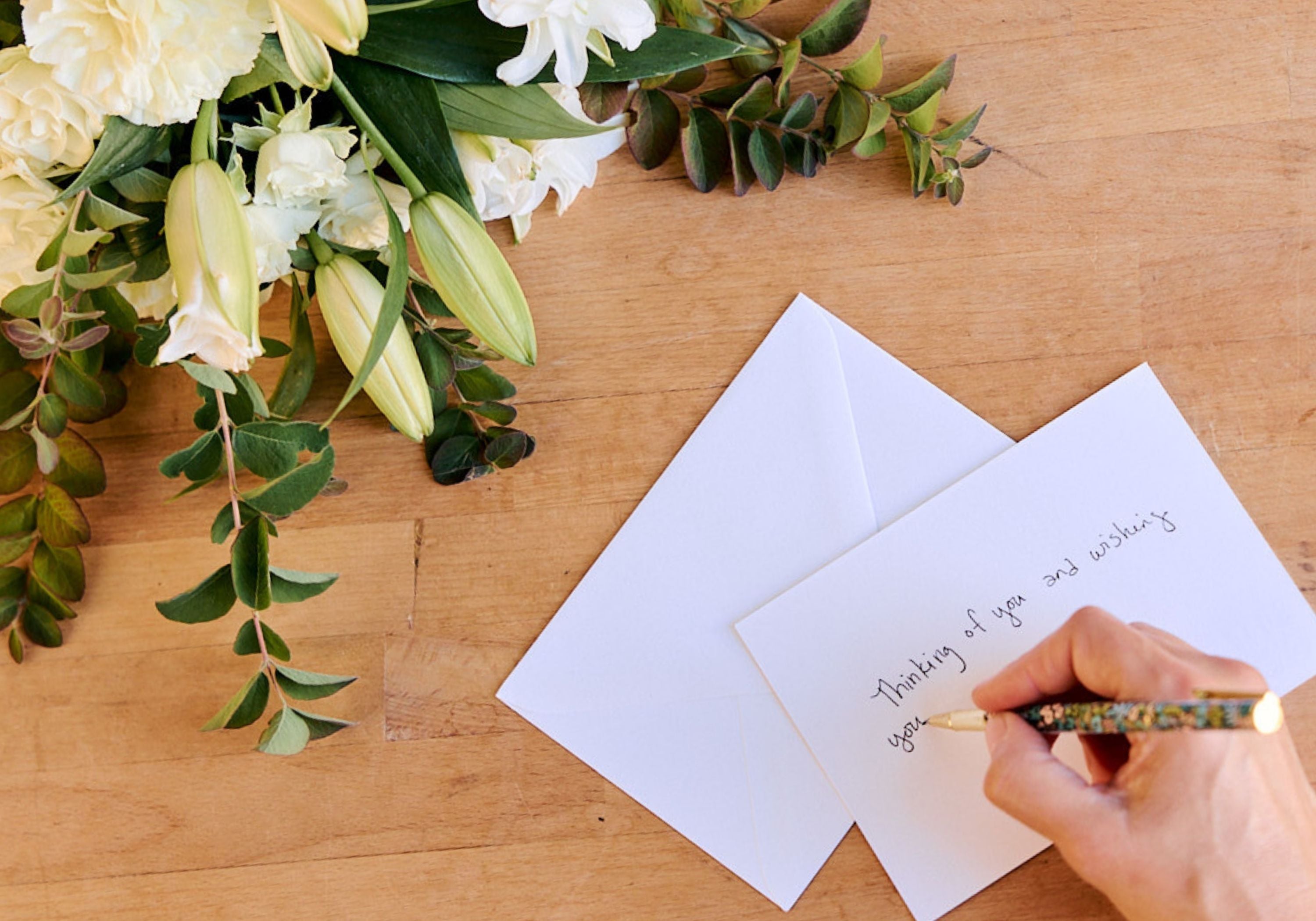
Obviously I have some experience with this one. If you’re sending sympathy flowers, you usually have even less room on the card, which can actually be helpful because it forces you to stop trying to solve grief in paragraph form. A short sympathy message on flowers can be as simple as, “Thinking of you and sending so much love,” or, “There are no words. I’m so sorry and I’m holding you close in my heart.”
If you knew the person who died, I love including their name: “Remembering Mary with so much love and thinking of all of you.” You can also just say, “I love you. I’m so sorry. I’m here.” Truly, you do not need to use every available character. The flowers are already doing some of the talking for you.
And yes, I know I own a flower company and am therefore not exactly an unbiased source on whether you should send flowers. But sympathy flowers aren’t meaningful because they fix anything. They very clearly do not. We send them because sometimes we need a physical way to show up when words feel too small. The flowers sit there and quietly say that someone is thinking about you, and sometimes that is enough too.
If it helps to see a few at a glance, here are a few that work for just about any situation:
- “Thinking of you and sending so much love.”
- “There are no words. I’m so sorry, and I’m holding you close in my heart.”
- “With deepest sympathy and so much love, from all of us.”
- “Remembering Mary with so much love and thinking of all of you.”
- “I love you. I’m so sorry. I’m here.”
- “Wishing you comfort and peace, today and in the weeks ahead.”
- “We’re thinking of you and your family and sending all our love.”
- “In loving memory of your dad, who meant so much to so many.”
- “Holding you in my heart until I can hug you in person.”
- “We’re so sorry for your loss. We love you and we're here, always.”
What Not to Write in a Sympathy Card
I really don’t love making hard rules about grief because people grieve so differently, and faith can also play a huge role in what brings someone comfort. But I personally try very hard not to explain someone’s loss to them. I stay away from things like “everything happens for a reason” or “they’re in a better place” unless I know very specifically that those words align with what that person believes and would find genuine comfort from them.
I also try to avoid any sentence that begins with “at least.” “At least you had thirty wonderful years together.” “At least she lived a long life.” “At least he isn’t suffering anymore.” I know those things are almost always said with love. We see someone hurting and desperately want to find one tiny piece of the situation that makes it less awful, but sometimes it is just awful. We can give people permission for that and not do anything that might make them feel like it’s being minimized — even if the intent was purely love.
You don’t have to find a silver lining in someone else’s grief. You can just sit beside them in it and let them know you’re there.
Is “I’m Sorry for Your Loss” Okay to Write?
Yes, absolutely. I sometimes see lists of “better things to say than sorry for your loss,” and I understand where those are coming from, but we don’t need to make people more anxious about this than they already are. “I’m so sorry for your loss” is kind, and if you mean it, you can write it.
You can make it a little more personal by adding one more thought, such as, “I’m so sorry for your loss. I’ve been thinking about you constantly and sending you so much love,” or, “I’m so sorry about your mom. I know how much she meant to you.” There is nothing wrong with familiar words when they’re sincere and coming from your heart.
Is It Okay to Write “I Don’t Know What to Say”?
This can actually be one of the best things to say when someone dies because sometimes (or really, often even in these situations) you genuinely don’t know what to say. You can write, “I don’t know what to say because nothing feels big enough for this. I’m just so sorry, and I love you,” or, “I wish I had better words. I don’t. But I’m thinking about you and I’m here.”
You are allowed to admit that grief has left you speechless. That’s not a failure, and it doesn’t make your message less comforting. If anything, it makes it more human because you’re not pretending there is some perfectly polished sentence that can make sense of something that doesn’t make sense.
Should You Mention the Person Who Died by Name?
If you knew them, I almost always would. Tell the story. Write, “I’ll always remember how your mom made everyone feel like family,” or, “I will never forget Tom dancing at your wedding,” or, “Every time I see dahlias I’m going to think of Marissa because she loved them so much.” Those little memories are gifts because they are something only you can give.
The person grieving already has their own lifetime of memories. Sharing yours gives them another little piece of the person they love that they might not have known about. And please don’t be afraid you’re going to remind them that the person died. You aren’t. They know. What you are reminding them of is that the person lived, and there’s a really important, and special, difference.
What If You’re Sending a Sympathy Card Late?
Send it. If you just learned about the death, send it. If the card has been sitting on your kitchen counter for two weeks because life got away from you, send it. If it has been a month and you keep thinking, “Well, now it’s probably too late,” it isn’t. Even if you lost touch with someone and find out a year later that their husband passed, send it.
There is so much support immediately after someone dies. There are phone calls and flowers and food and cards and people asking what they can do, and then everyone else, understandably, has to go back to their regular lives. The person grieving does too, except their regular life doesn’t exist anymore in the same way, and that’s excruciatingly hard for them.
A card that arrives three weeks late, or even a year later, may be exactly what they need that day. You can even say, “I know some time has passed, but I’ve been thinking about you and wanted you to know I’m still thinking about your dad too.” There is no expiration date on caring about someone. And that goes for sympathy and beyond.
What Do You Say When You Truly Have No Words?
You tell the truth. You can say, “There really are no words for this,” and then give them whatever you do have. You can tell them you love them, that you’re thinking about them, that you’re there, that you remember the person they lost and that you’re so sorry.
We sometimes believe that because we cannot make someone feel better, whatever we have to offer isn’t enough. But grief isn’t asking us to make it better. It’s asking us to show up, and especially now, when so many people seem to be carrying things we know nothing about, showing up for one another matters more than we sometimes realize.
So write the card. Send the text. Tell the story. Say their name. Check in again when a few weeks have passed. You don’t need perfect words, and you don’t need to make their grief smaller. You just need to care enough to use the words you have and to keep showing up even after you’ve used them.
And if you'd like to send flowers too, here's what we'd send.

A Few Questions I Get Asked a Lot
How long should a sympathy card message be?
Two or three sincere sentences are plenty. A short message that sounds like you means more than a long one that feels formal, forced, or generic. “I’m so sorry. I love you and I’m here” is a complete sympathy message — truly, the whole thing.
Is it ever too late to send a sympathy card?
No. Grief lasts far longer than the first few weeks of casseroles and phone calls, and a card that arrives a month or even a year later often lands exactly when the rest of the world has moved on and the person needs it most. Send it.
Should I mention how the person died?
Generally, no. Your card doesn’t need to reference the cause at all — it only needs to say that you care and that you’re there. Follow the grieving person’s lead: if they’ve spoken openly about it, you can acknowledge it gently, but you never have to.
Is it okay to text instead of sending a card?
A kind text is far better than silence, so if a text is what you’ll actually send, send it. But a card can be held, kept in a drawer, and reread on the hard days — and people do exactly that, more than you’d guess. When in doubt, do both.
xx,
Christina

Christina Stembel is the founder and CEO of Farmgirl Flowers, which she started in 2010 and grew into one of the largest women-founded e-commerce flower companies in the country. She has personally read thousands of the card messages sent with Farmgirl’s sympathy arrangements.