


Anniversary Flowers by Year: The Traditions, the Meanings and When to Ignore All of It
Sep 16, 2026
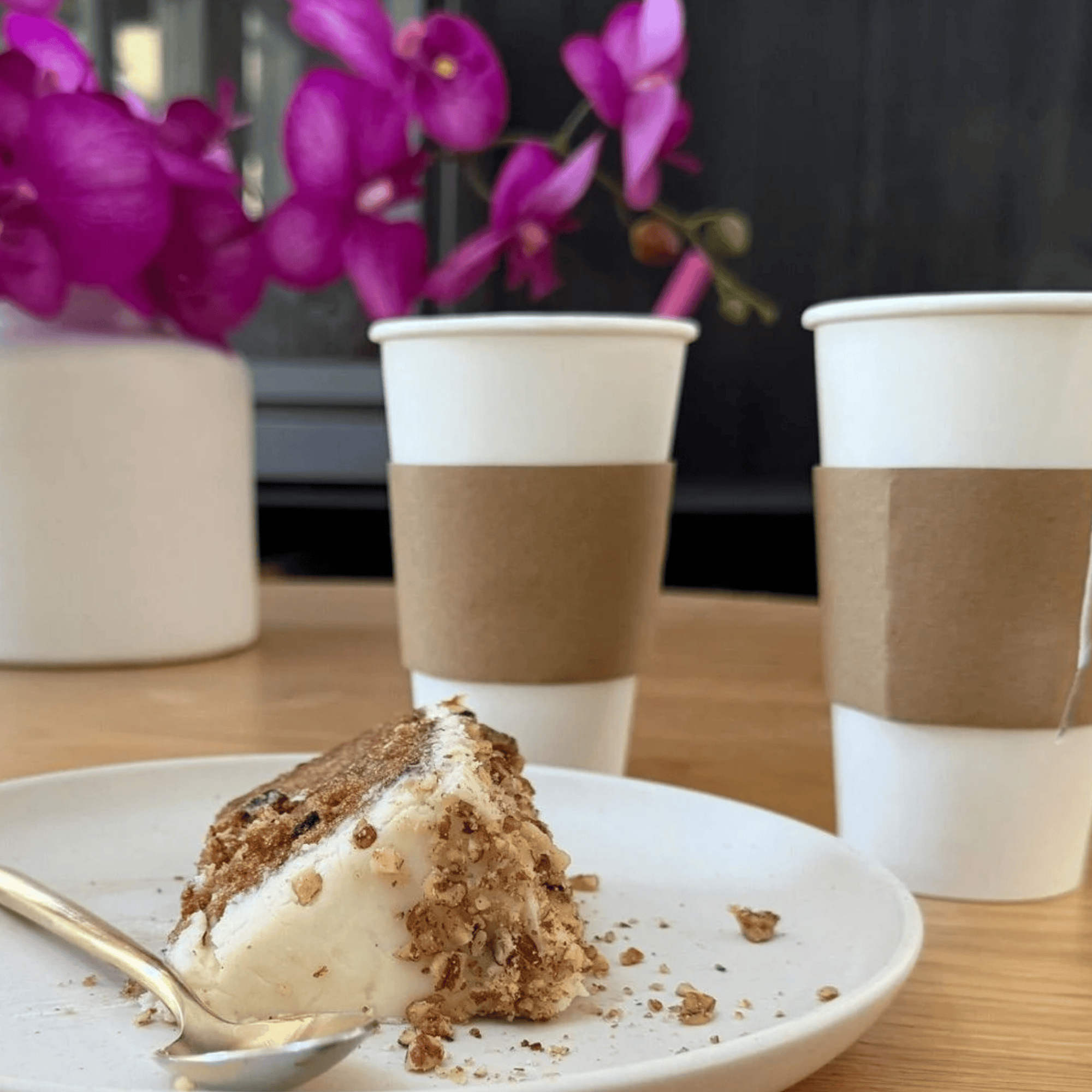
A few weeks ago it was my first wedding anniversary, and wow, did I get it right this time. What's that about a first pancake? I'm one of those people who needed a very burnt first pancake to get to the absolutely perfectly golden brown second one.
We spent the weekend at a beautiful wedding in Oregon, for a super special couple that's part of a family that's the one you want to be in. You know the one, right? The one where even if they weren't family, they'd probably pick each other anyway. It's pretty awesome. But I digress — back to my anniversary. That morning my husband had to drop me off at the airport to fly home. So rather than waking up in an exotic location with rose petals, room service, and whatever else people who are much better at anniversary planning than we are apparently do, we woke up at a hotel and drank coffee together before heading to the airport.
At some point we looked at our coffee cups and realized that paper is the traditional first-anniversary gift. So technically, we nailed it. Two lovely paper coffee cups. Happy anniversary to us!
But the funny thing is, I actually feel like I got exactly what I wanted for my first anniversary. It just wasn't wrapped. My husband has spent an absolutely ridiculous number of hours working with me at Farmquarters lately. Excavating, irrigating, weed-clothing (that one definitely deserves to be a verb!), planting, building, hauling, schlepping, scheming, etc. He's done it all.
Acts of service are a very big deal to me, and there are few things that say I love you more clearly in my particular language than someone picking up a shovel and helping me make a place I love even more beautiful. So, yes, our official paper gifts were coffee cups. But my actual anniversary gift was a whole lot of love shown every single day. Not just on our anniversary.
Which got me wondering: if paper is the traditional gift for the first anniversary, is there a traditional first-anniversary flower, too? Because, as the owner of a flower company, I'm embarrassed to say it took me more than 15 years to think about that.
And I found that of course there is. Apparently marriage has a whole flower chart — anniversary flowers by year, one for nearly every year you've been at this — which makes me exceptionally happy.
What Are the Traditional Anniversary Flowers by Year?
There are traditional anniversary flowers associated with many anniversary years, much like the better-known anniversary gift list of paper, wood, tin, silver and gold. Of course we all know the silver and gold ones!
One little caveat before you panic-order a bouquet: unlike the traditional anniversary gift list, there isn't actually one universally agreed-upon flower list. You'll find some variation depending on where you look, particularly in those early years. Some lists give year three to sunflowers and others to fuchsia; year eleven is tulips in one book and morning glories in another. The most commonly used anniversary flowers, though, are consistent enough: carnations for the first anniversary, daisies for the fifth, daffodils for the tenth, roses for the fifteenth, irises for the twenty-fifth and yellow roses with violets for the fiftieth. The funny thing (to me, anyway) is that most of those flowers aren't what your person actually wants — and I've got more than 15 years of anniversary orders to back me up on that.
So after reading through the traditional anniversary flower list, and scratching my head a bit, I thought I'd make my own — based partly on more than 15 years of doing this, and partly on what I've watched our customers actually reach for. Case in point: three of our five best-selling anniversary bouquets over the past year were peony bouquets. People know what they want, and what they want is peonies. Peonies aren't a year-round flower, though. So if you want peonies on every anniversary, you'd have to plan your wedding around the peony harvest — which is completely unreasonable advice, and also exactly what I would do.
I gave myself one rule while I was building it: every flower on my list has to be able to carry a bouquet by itself. No filler, no supporting cast, no "and a few stems of something to round it out." If it's going to be your anniversary flower, it should be able to walk into the room alone and have the room notice. That rule knocked out a few of the traditional picks immediately, and it's why some of my swaps look like upgrades of the tradition rather than replacements of it. Same color, same story, better flower.
Take my version for what it is, though: a best guess at what your person wants, based on the year. If you're one of those amazing humans who actually knows what your love wants, disregard this list completely and just buy them that — and do it every year, even if it's the same thing year after year. I promise that's the absolute best thing to do.
Or tie it to a number that's significant to you that year instead of the number of years you've been together. Or to whatever financial position you're in that year. For instance: if you're in the middle of a really hard year, and you know she loves garden roses, and garden roses are super expensive (which they are!), how about one stunning stem, popped into a bud vase (or a bottle from the recycling bin), left on her bedside with a note saying there's no one in the world you'd rather do the hard times with? I guarantee that would mean more to her than three dozen garden roses she'd spend the whole evening worrying about the cost of instead of cherishing the moment for what it is.
Here's the quick version — the traditional flower for each year, what I'd actually send, and why.
- 1st — Carnations. Our pick: tulips (Oct–May). Not in season: garden roses in your wedding color. The flip. Year one is still basically an extension of the wedding, and a tulip is a cost-effective, wedding-adjacent classic.
- 2nd — Lily of the valley or cosmos. Our pick: lisianthus (year-round). Both traditional picks are rough. Lisianthus looks like a rose that decided to be softer about it, and it outlasts nearly everything.
- 3rd — Sunflowers. Our pick: sunflowers (year-round). Keeping it. Three years in you've found your rhythm, and there's no more literal way to say "you make everything brighter."
- 4th — Hydrangeas or geraniums. Our pick: hydrangeas (year-round). Easy call — geraniums are a porch plant, not a cut flower. One enormous head in a vase is a complete arrangement.
- 5th — Daisies. Our pick: gerbera daisies (year-round). Keep the daisy, grow it up. Massed in one deep color, or the fringed spider varieties, they look nothing like the mixed bunch you're picturing.
- 6th — Calla lilies. Our pick: calla lilies (year-round, best spring–summer). Keeping it. Callas are sculptural, elegant and completely unbothered.
- 7th — Freesia. Our pick: anemones (year-round). Freesia is thin on its own. Anemones have that inky dark center and look like nothing else in the cooler.
- 8th — Lilac (sometimes clematis). Our pick: stock (year-round, best winter–spring). Lilac has a famously short season and truly hates being cut. Stock is its available cousin — same fluffy spires, same fragrance, a little spicier.
- 9th — Bird of paradise. Our pick: anthurium (year-round). Still tropical, glossier, better shape. They'll look as good in week three as they did on day one.
- 10th — Daffodils. Our pick: Hanoi ranunculus (year-round). Daffodils are no help if you didn't have a spring wedding. Hanoi ranunculus open in impossible layers of tissue-thin petals. A decade earns the upgrade.
- 11th — Tulips. Our pick: specialty carnations (year-round). The other half of the flip. The antique and muted varieties look nothing like what you're picturing, and they last two to three weeks without a single complaint.
- 12th — Peonies or lilies. Our pick: snapdragons (year-round). Peonies are saved for year 20 and lilies for year 30. Snapdragons open from the bottom up all week, so the arrangement is different every day.
- 13th — Chrysanthemums. Our pick: garden spray roses (year-round). One stem does the work of five, and most people can't name what they're looking at.
- 14th — Dahlias or orchids. Our pick: dahlias (midsummer–first frost). Not in season: ball and pompon chrysanthemums, the closest year-round look. Dahlias are the drama queens of the flower world and worth every bit of it.
- 15th — Roses. Our pick: garden roses (year-round). The rose year gets the best rose there is. Huge, ruffly and wildly fragrant.
- 20th — Asters. Our pick: peonies (late Apr–June). Not in season: garden roses bred to look like peonies. Twenty years is a peony year — the most requested flower we have.
- 25th — Irises. Our pick: cymbidium orchids (Oct–May). Not in season: lilies. The most quietly expensive-looking flower we carry. Silver anniversary, silver-screen flower.
- 30th — Lilies. Our pick: double lilies, so many of them (year-round). Thirty years should be abundant. Twice the petals, no pollen to stain anything.
- 35th — Coral roses. Our pick: Coral Charm peonies (late Apr–June). Not in season: coral garden roses (year-round). Coral Charm fades from near-red through coral to cream over a week.
- 40th — Gladiolus. Our pick: protea (year-round). The oldest flowering plants on earth, and the South African varieties evolved to survive wildfire. Strength and integrity, literally.
- 45th — Blue irises. Our pick: delphinium, true blue (spring–fall). Not in season: blue hydrangea (year-round). Keeps the blue, the height and the spire, and swaps in a flower you can actually buy.
- 50th — Yellow roses & violets. Our pick: garden roses in butter and gold, as many as you can carry (year-round). Golden anniversary, so keep the gold and upgrade the rose. After half a century you should get an armful.
One thing I noticed while making this: tradition gives carnations to year one and tulips to year eleven. I've flipped them. Tulips are the classic, and year one is still basically an extension of the wedding — whereas carnations are resilient and hardworking, and eleven years in, that's the compliment you actually want.
And to be clear, that third column is not me overruling anybody. If your person loves the traditional flower, the traditional flower wins every single time. This is just what I'd reach for if I had no idea what to send.
You'll notice the list starts getting a little less committed to annual assignments after year fifteen. I choose to believe this is because by then you've proven yourselves, and you really know your person by then so you are absolutely allowed to freelance.
Also, please don't look at this chart and think you now have to locate an out-of-season lilac in December or your marriage is doomed. This is supposed to be fun!
What If Your Anniversary Flower Isn't in Season?
Then you send something else. That's the whole answer, full stop.
Here's the thing nobody mentions about flower charts: they were written by people who were not thinking about February. Flowers are seasonal — genuinely, stubbornly seasonal — and whoever assigned lilac to year eight did not pause to consider that lilac is available for about three weeks a year and despises being cut. Same energy for cosmos, lily of the valley, daffodils and bearded iris. Beautiful, all of them. Available on the third Tuesday of October when your anniversary happens to fall, unfortunately no.
So here's the honest version, in three tiers, because "in season" is less of a yes-or-no question than people think.
Truly year-round. Roses, garden roses, spray roses, lilies, sunflowers, hydrangeas, carnations, chrysanthemums, gerbera daisies, calla lilies, lisianthus, snapdragons, stock, anemones, ranunculus, anthurium and protea. That's your safety net, and it's a good one — there isn't a bad flower on that list. It's also why most of my picks in the chart are pulled from it.
Long season, but not year-round. Tulips and cymbidium orchids both run roughly October through May, then largely disappear for the summer.
Anemones and ranunculus used to sit in that middle tier too, and a lot of flower charts still have them there. Not anymore. Growers in the Ecuadorian highlands worked out how to produce both at altitude on the equator, where the day length barely moves all year — and the result is anemones and ranunculus in August. It's one of my favorite examples of the flower world quietly solving a problem everyone had simply accepted.
Genuinely short. Peonies run late April through June in most of the country, though Alaska stretches the domestic season into late summer and there's a brief imported window around the holidays. Dahlias run midsummer to first frost. Delphinium runs spring through fall. And lilac, lily of the valley, daffodils, cosmos and bearded iris are all a matter of weeks.
But I want to be straight with you about what "year-round" means, too, because you deserve to know: usually it means that flower traveled a very long way to get to you in the off-season. That doesn't make it less beautiful — but a flower at the peak of its actual season is a better flower, period. Better price, longer vase life, and it looks like it wanted to be there.
You'll notice six of my picks are seasonal, and that isn't an accident — they're mostly on the milestone years. A fifth anniversary should be easy to pull off on a Tuesday. A twentieth is worth putting on the calendar.
So if your anniversary lands in the wrong month for your assigned flower, my honest advice is to let the chart go and buy whatever is spectacular that week. Ask whoever is selling you flowers what just came in. It's the single best question in all of flower-buying, and almost nobody asks it.
The chart is a suggestion. Not a shame inducing scavenger hunt, promise!
1st Anniversary Flowers: Carnations (our pick: Tulips)
So here I am on anniversary number one, and apparently my flower is the carnation.
Carnations traditionally represent things like love, fascination and devotion, which actually feels pretty appropriate for the first year of marriage. They're also incredibly hardy and can last forever in a vase, which is an admirably optimistic bit of symbolism to assign to a marriage at year one.
I've moved them, though. Not because I don't love them — I do, and I'll make the whole case down at year eleven, where I think they belong. Resilient and hardworking is a compliment you have to earn, and I have been married for one (1) year.
What I'd send for a first anniversary is tulips.
Year one is still basically an extension of the wedding. You've still got the photos on the fridge, you're still saying "my husband" like you're trying it on, and a tulip is a very wedding-adjacent flower — simple, elegant, completely unbothered by trends. They also do that thing where they keep growing in the vase and rearrange themselves overnight, which, one year in, is either a lovely metaphor or a warning. I've decided it's lovely.
Bonus points for tulips in your wedding color. And if they don't come in your color, get white ones and wrap them in paper that is. (Paper. First anniversary. You're welcome.)
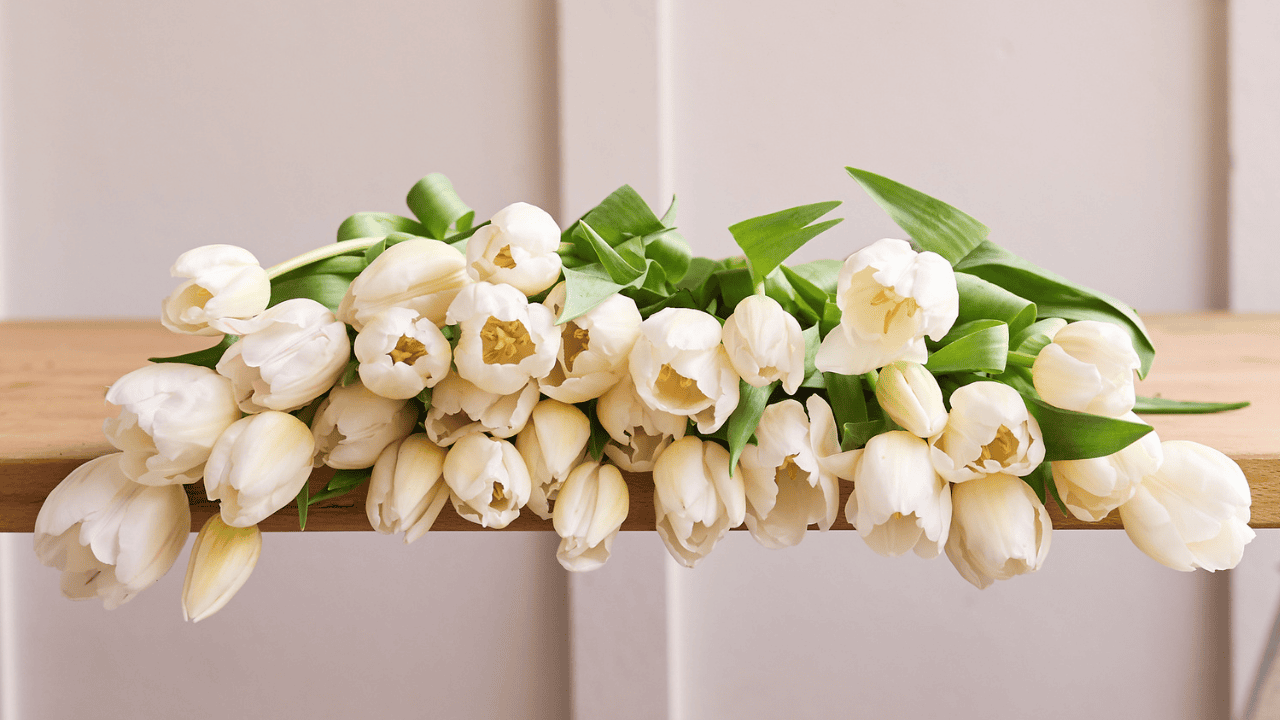
One heads-up: tulips run October through May, and a lot of weddings happen in September and October, which means a lot of first anniversaries land right at the edge of tulip season or just past it. If yours does, garden roses in your wedding color do the same job.
Would I have traded all the things my husband planted for me for a bouquet of carnations? I love carnations, but Keith, if you're reading this: absolutely not. Please do not start digging things back up. I love your acts of service even more than a giant vase of tulips, or — because our anniversary is in August — carnations.
The person wins.
2nd Anniversary Flowers: Lily of the Valley or Cosmos (our pick: Lisianthus)
Year two traditionally gets lily of the valley or cosmos, depending on which list you're reading. Both are associated with sweetness, new happiness, and the tender early part of things.
Both are also rough as cut flowers, and I say that with love. Cosmos wilt almost immediately once they're cut. Lily of the valley has a season you could miss by blinking, and it's expensive enough that you'd feel it.
I'd send lisianthus instead. It looks like a rose that decided to be softer about it, it comes in the exact pale, tissue-papery colors people want for a second anniversary, and it will outlast almost everything else in your house. Soft and durable at the same time, which is about right for year two — you're past the wedding, you're not yet the people who've weathered anything, and you're figuring out that the sweet thing and the sturdy thing can be the same thing.
3rd Anniversary Flowers: Sunflowers
Three years gets sunflowers, associated with adoration, loyalty and warmth. Some lists give year three to fuchsia instead, but sunflowers are the one that stuck, and I'm glad.
Keeping it. No notes.
Three years in, you've found your rhythm. You know how the other one takes their coffee, you've survived at least one truly stupid argument about a piece of furniture, and there is no more literal way to say "you make everything brighter" than a flower that spends its entire life turning to follow the sun.
Sunflowers are also available year-round, they're cheerful without being twee, and a big armful of them is genuinely hard to beat. Get the ones with the dark centers if you want them to look expensive.
4th Anniversary Flowers: Hydrangeas or Geraniums (our pick: Hydrangeas)
The fourth-anniversary flower is the hydrangea, sometimes listed as the geranium.
Easy call: geraniums are a porch plant, not a cut flower, and nobody has ever been swept off their feet by a geranium - although they do smell great!
Hydrangeas, though — keeping those. They're timeless and elegant and slightly old-money-looking, and a few stems make a whole room look like you meant it. Which, four years in, you obviously do.
They're available year-round, they come in that whole antique range from ice blue to dusty green to bruised burgundy, and a couple of enormous stems in a vase make a complete arrangement. They do like a lot of water and they will absolutely faint if you forget, so recut the stems and top up the vase daily. They also get some of their water through their petals, so give them a good dunk and they’ll thank you for it. Consider that the price of admission.
5th Anniversary Flowers: Daisies (our pick: Gerbera Daisies)
The traditional flower for a fifth wedding anniversary is the daisy, which represents loyalty, innocence and cheerfulness.
And it's hard to argue with a daisy. They might be one of the happiest flowers on earth. They're unfussy and nostalgic and somehow make everything they're arranged with look like it just wandered in from a field.
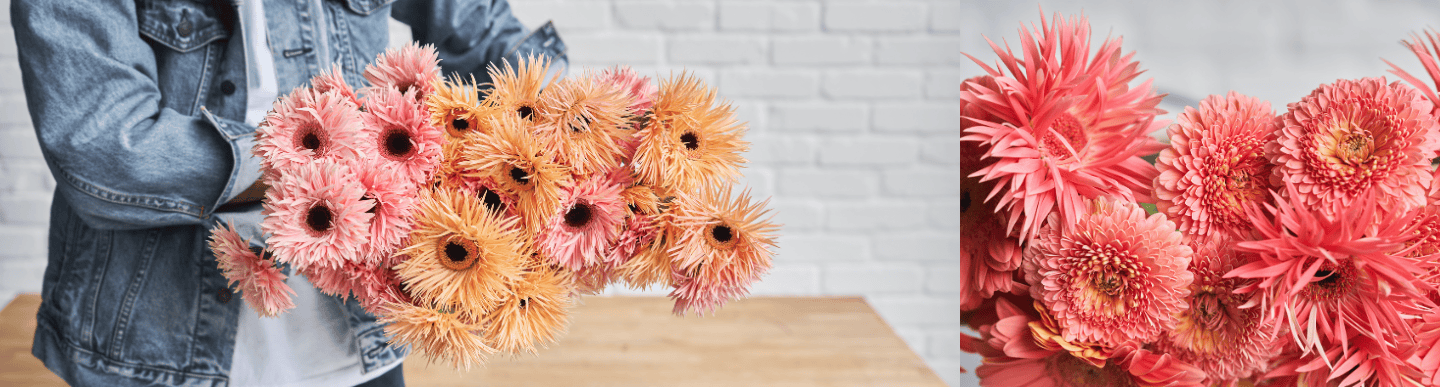
Here's my one adjustment: I'd send gerbera daisies.
Same flower family, same open-faced cheerfulness, but grown all the way up. A mass of gerberas in one deep color — rust, plum, a proper hot coral — looks nothing like the mixed-bunch version you're picturing. And the fringed spider or curly pasta varieties are genuinely spectacular, with these long, shaggy petals that make them look like something much rarer than they are. They're available year-round, they come in essentially every color, and they hold their heads up for well over a week.
If the person you're celebrating loves daisies, this one is easy. If they have never expressed a single positive thought about daisies but have mentioned approximately 47 times that peonies are their favorite flower, I would not arrive home clutching daisies and announce, "BUT TRADITION."
This is going to become a theme.
6th Anniversary Flowers: Calla Lilies
Six years gets the calla lily, associated with devotion, beauty and — depending on which source you trust — a kind of quiet magnificence.
Keeping it, no changes.
Callas are sculptural and elegant and completely unbothered, which is exactly what year six feels like. This is around the point where you stop performing the marriage for anybody and just get on with being good at it. Callas have never performed for anyone in their lives.
They're available year-round, they're best spring through summer, and they come in everything from white to that almost-black plum. A dozen of them in a tall vase with nothing else in it is one of the most striking things you can put in a room.
7th Anniversary Flowers: Freesia (our pick: Anemones)
Freesia is the traditional seventh-anniversary flower, associated with trust and lasting friendship — which is a lovely thing to assign to the year everybody makes jokes about.
I'd send anemones instead.
Freesia smells incredible, but it's thin on its own and much happier mixed into a bouquet than starring in one, and my whole rule for this list was that every flower has to be able to carry the room alone. Anemones can. They've got that inky dark center against a clean white or deep purple petal, and they look like nothing else in the cooler. Slightly moody, a little unexpected, quietly dramatic.
Which is a good energy to bring to year seven, honestly.
And here's the part most flower charts haven't caught up with: anemones used to be a winter flower, full stop. Growers in the Ecuadorian highlands changed that — at altitude on the equator the day length hardly shifts all year, so anemones now come in essentially year-round. Whenever your seventh lands, you can get them.
8th Anniversary Flowers: Lilac (our pick: Stock)
Eight years traditionally gets lilac — sometimes clematis — associated with first love and the memory of it.
Lilac is a beautiful assignment and a completely impractical one. It's available for about three weeks a year, it wilts if you look at it wrong, and it truly hates being cut.
Stock is its available cousin, and that's what I'd send. Same fluffy spires, same ruffled density, and a fragrance that's every bit as good — a little spicier, a little more clove-like. It's grown in California essentially year-round, it's best in winter and spring, and it comes in exactly the antique lavenders and creams and dusty pinks that make people think "lilac" in the first place.
Eight years in, you're allowed to want the beautiful thing and also want it to still look good on Thursday.
9th Anniversary Flowers: Bird of Paradise (our pick: Anthurium)
Nine years gets bird of paradise, associated with joy, freedom and a certain amount of showing off.
I love the instinct here. Nine years is a genuinely great year — you're deep enough in to be sure of it, not so deep that anybody's calling it a milestone — and it deserves a flower with some nerve.
I'd go anthurium.
Same tropical confidence, glossier finish, better shape. Anthuriums look like someone made a flower out of patent leather, they come in white and coral and a red so deep it reads black, and they will sit in a vase looking exactly as good in week three as they did on day one. Nothing else on this chart does that.
They're available year-round, so this one solves itself no matter when your anniversary lands.
10th Anniversary Flowers: Daffodils (our pick: Hanoi Ranunculus)
Ten years gets daffodils, which are associated with renewal, joy and new beginnings.
I actually love this one. There is something hopeful about assigning a flower that comes up at the beginning of spring to a marriage that's already a decade old. Ten years isn't the beginning, obviously, but maybe that's the point. You can have new beginnings inside something you've been building for a long time.
The practical problem is that daffodils have the audacity to only bloom when daffodils bloom.
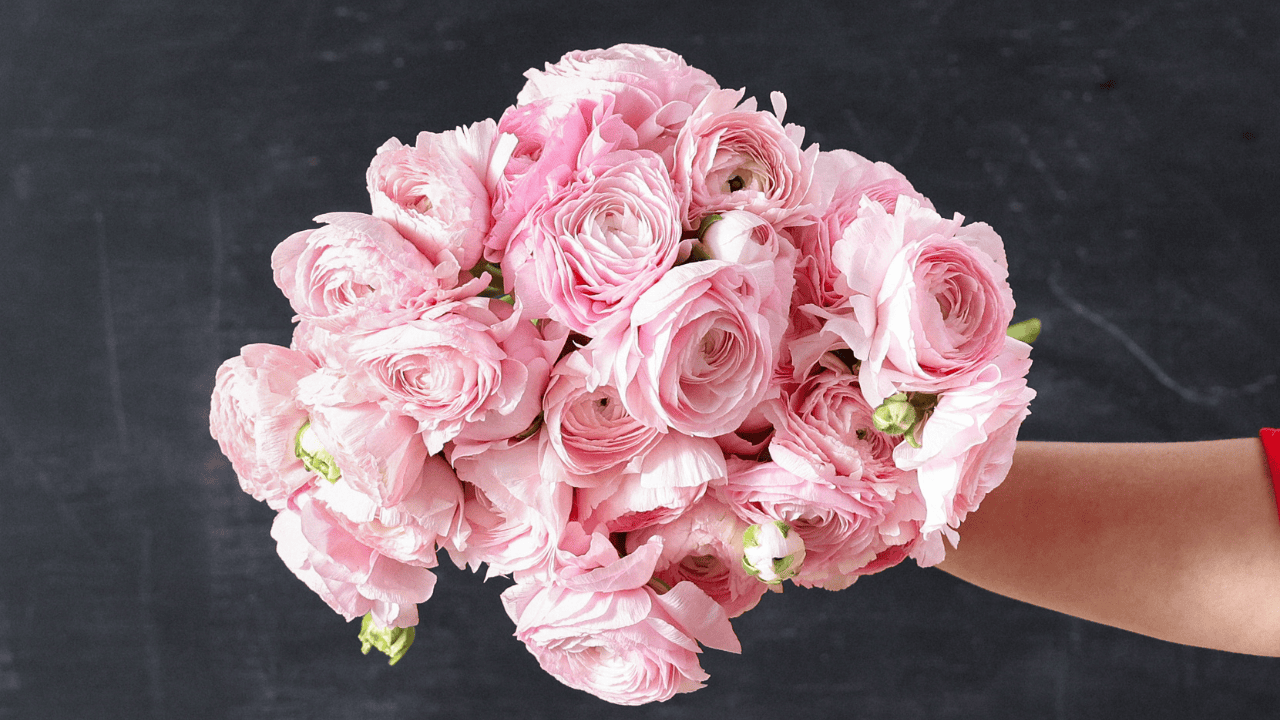
So for a decade, I'd switch it to Hanoi Ranunculus, which are essentially the peony of the ranunculus world. Almost everyone thinks they’re a peony because they’re just that beautiful. They open in these impossible layers of tissue-thin petals — dozens of them per stem, tightening toward the center — and a bunch of them is one of the prettiest things we sell. A decade earns the upgrade.
And ranunculus have quietly become a year-round flower — the Ecuadorian highland growers again — so a tenth anniversary in August is no longer the problem it used to be. If she'd rather have garden roses in her favorite color, though, that's always my other vote for a decade.
11th Anniversary Flowers: Tulips (our pick: Carnations)
Year eleven traditionally gets tulips, though a few lists give it morning glories. And this is the one where I've swapped the tradition on purpose: I gave the tulips to year one, and I'm giving year eleven the carnations.
Here's my case.
Carnations have gotten a bad rap over the years, and it's entirely undeserved. There are some genuinely beautiful varieties now — the antique, blush and muddy tones that look nothing at all like the red-and-white grocery-store carnations most of us are picturing. The Florigene and antique varieties in particular come in these smoky, faded, almost dusty shades that are hard to find in any other flower at any price.
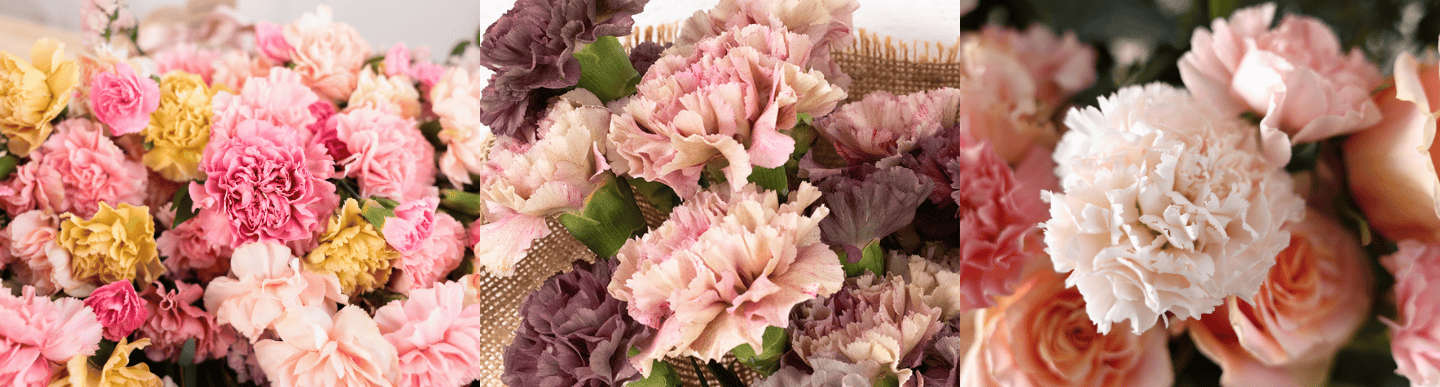
They're also resilient and hardworking. They last two to three weeks in a vase, which is longer than almost anything else you can buy, and they do it without any fuss whatsoever.
Eleven years in, resilient and hardworking is the best compliment there is. Nobody gives you a party for eleven. You're just quietly still doing it, still choosing it, still good at it. That's a carnation.
I can't wait to get there.
12th Anniversary Flowers: Peonies or Lilies (our pick: Snapdragons)
Year twelve gets peonies on some lists and lilies on others.
I'm going to disappoint both, because I'm saving peonies for the real milestone at year twenty and lilies for year thirty, and I'd rather not spend a flower twice.
So: snapdragons.
Nothing else on this chart has that shape — tall, spired, a little architectural, with the blooms opening from the bottom of the stem upward over the course of a week, so the arrangement is quietly different every day you look at it. They're available year-round, they come in every color including some remarkable bronzes and antique whites, and a tall vase of nothing but snapdragons looks far more expensive than it is.
Twelve years, still climbing. I'll allow the metaphor.
13th Anniversary Flowers: Chrysanthemums (our pick: Garden Spray Roses)
Thirteen years gets chrysanthemums, associated with loyalty, longevity and cheerfulness. It's also the year everyone pretends isn't on the list.
I'd send garden spray roses.
Thirteen years in, you're usually the couple quietly making everything else work — the ones who host, who show up, who drive somebody to the airport at 5 a.m. Garden spray roses do exactly that, floral-arrangement-wise. Multiple small, fully double, garden-rose-shaped heads on a single stem, so one stem does the work of five. They're available year-round, they're endlessly romantic, and the specialty garden varieties are so unusual that most people can't name what they're looking at.
They'll just keep saying "what are those?" all week. Which is, frankly, the whole point of a good flower.
14th Anniversary Flowers: Dahlias or Orchids (our pick: Dahlias)
Fourteen years gets dahlias or orchids, associated with elegance, dignity and lasting commitment.
Keeping the dahlias. They're the drama queens of the flower world and worth every bit of it — the dinner-plate varieties get as wide as your face, the ball and pompon varieties are these perfect geometric spheres, and the color range runs from butter yellow to a burgundy so dark it's nearly black. Nothing else looks like a dahlia.
They also flatly refuse to exist in February. Domestic dahlias run midsummer to first frost, with imports stretching that a bit at the edges, so plan accordingly. If your fourteenth is a winter one, the ball and pompon chrysanthemum varieties get you closest to the same look year-round, and most people don’t know the difference.
15th Anniversary Flowers: Roses (our pick: Garden Roses)
Finally. At fifteen years, tradition gives you the rose.
This is probably the least surprising entry on the entire anniversary flower list because roses have been connected to romantic love for centuries. Red roses in particular have become such shorthand for romance that we've almost stopped thinking about why. (If you want the long version of how that happened, I went down a whole rabbit hole on it in our guide to the language of flowers.
And I should probably admit here that I have complicated feelings about the automatic dozen-red-roses move.
I love roses. We grow a lot of them. I especially love garden roses — the huge, ruffly, wildly fragrant varieties that look like someone crossed a rose with a peony and then gave it a trust fund. That's my pick for fifteen: the rose year should get the best rose there is, and that's a garden rose.
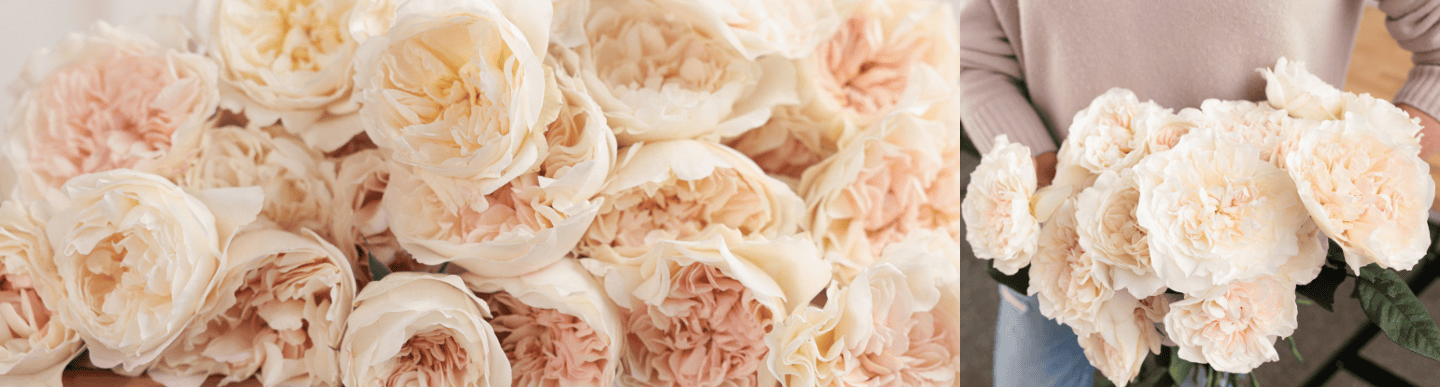
But I don't think red roses are automatically romantic just because we've collectively decided they are. If your person loves red roses, please send red roses. If they love blush garden roses, send those.
If they carried peach garden roses down the aisle at your wedding and you can recreate even part of that bouquet fifteen years later? Now we're talking. That's romantic because you remembered.
20th Anniversary Flowers: Asters (our pick: Peonies)
The traditional twentieth-anniversary flower is the aster, a flower commonly associated with love, patience and wisdom.
Which feels appropriate after twenty years because I assume patience has become less of an abstract virtue by then and more of a highly practiced marital skill.
Asters also have that lovely wildflower quality I always gravitate toward. They aren't screaming for attention. They just make everything around them prettier. There's probably a marriage metaphor in there somewhere, but I'm only one year in, so I will stay in my lane.
I'll say one thing though, and you'll see it in the chart: if you're planning a twentieth, I'd go peonies instead. Two decades is worth timing a celebration around a flower with a six-week season, and peonies are the single most requested flower we have. They're also the one flower I've watched people react to physically — there's an actual gasp that happens when someone opens a box of peonies, and I have never gotten tired of it.
Domestic peonies run late April through June, Alaska stretches the season into late summer, and there's a brief imported window around the holidays from further away. If your twentieth falls outside all of that, there are garden rose varieties bred to look almost exactly like peonies. They really do exist, promise!
25th Anniversary Flowers: Irises (our pick: Cymbidium Orchids)
Twenty-five years is the silver anniversary, and the traditional anniversary flower is the iris.
Irises are often associated with faith, hope and wisdom, which feels considerably more earned after a quarter century together than some of the symbolism we've assigned to the earlier years.
And twenty-five years deserves something special. My pick here is cymbidium orchids.
They're probably the most quietly expensive-looking flower out there — a single arching stem holds so many waxy, perfectly formed blooms in white, green, blush or butter, and they'll last three weeks without complaint. Silver anniversary, silver-screen flower. They run October through May, which conveniently covers most of the year people actually throw twenty-fifth anniversary parties.
If she loves irises, though, keep the irises. Twenty-five years means you know. And you could absolutely use either one as the starting point for the bouquet rather than feeling like you have to send an enormous bunch of nothing else. Mix them with flowers your person loves. Pull in something from the wedding bouquet. Choose colors they actually decorate their house with.
The anniversary year can give you the idea. It doesn't have to dictate the entire bouquet.
30th Anniversary Flowers: Lilies (our pick: Double Lilies — often called Rose Lilies)
Thirty years gets lilies, which I personally think is a pretty good assignment.
They're dramatic without trying too hard, they're incredibly fragrant, and the really beautiful varieties can turn into these enormous, almost sculptural flowers as they open.
My one amendment: double lilies, and a lot of them. The doubles are unique, amazing and genuinely abundant — twice the petals, no pollen to stain anything, and they keep opening into something bigger all week. Thirty years should feel like that. Thirty years should take over an entire room.
If your spouse loves lilies, great. If your spouse spends the entire time they're in the house complaining about the pollen, the doubles solve that specific marital dispute, and if they're still not having it, this is another excellent opportunity to disregard tradition.
Marriage preserved. You're welcome.
35th Anniversary Flowers: Coral Roses (our pick: Coral Charm Peonies)
Thirty-five years is the coral anniversary, so tradition hands you coral roses.
I'd keep the coral and change the flower: Coral Charm peonies. If you've never seen one, it's the most theatrical thing in the peony world. It opens a deep, almost salmon-red, then fades over about a week through coral to apricot to a pale buttery cream — so a single vase of them is a completely different arrangement on Friday than it was on Monday. Thirty-five years of watching something you love change into something else you love. I don't need to draw you a picture.
They're in season late April through June. If your thirty-fifth lands somewhere else on the calendar, coral garden roses are a beautiful consolation prize and available year-round.
40th Anniversary Flowers: Gladiolus (our pick: Protea)
The traditional flower for forty years of marriage is gladiolus, often associated with strength and integrity.
And I like that forty years gets a flower that looks strong. Gladiolus grow on these long, upright stems with bloom after bloom opening their way up the stalk. They're dramatic, architectural and impossible to miss.
Forty years together should probably be impossible to miss, too. But if I'm choosing on strength and integrity, I'm sending protea.
Protea are the oldest flowering plants on earth, and the South African varieties evolved to survive wildfire — the plant burns, and then it comes back. A king protea is the size of a dinner plate, looks like something out of a natural history museum, and will dry in place and sit on your shelf for years afterward, a little browner, but still perfect. Available essentially year-round.
Forty years, still here, still standing, arguably better for it. I can't think of a better match. Though if it were my fortieth, I'd still want an unreasonable quantity of the flowers I actually love. Forty years earns you that. Luckily for me, there are few flowers I love more than a king protea, so I’m looking forward to my 40th in about 39 years!
45th Anniversary Flowers: Blue Irises (our pick: Blue Delphinium)
Forty-five years traditionally gets blue irises, associated with faith, hope and valor. I'd send delphinium instead though.
It keeps everything good about the assignment — the blue, the height, the spire shape — and swaps in a flower you can actually buy. Delphinium comes in a true, saturated cobalt that almost nothing else in the flower world does, it grows on stems tall enough to be genuinely architectural, and a big armful of it is startling in the best way. It runs spring through fall.
Forty-five years of faith, hope and valor deserves a flower people stop and stare at. Blue hydrangea is your backup if delphinium isn't around. Either one is almost worthy for the huge accomplishment that is 45 years of marriage.
50th Anniversary Flowers: Yellow Roses & Violets (our pick: Butter Yellow or Gold Garden Roses)
If you make it to fifty years, wow! And congratulations!
Yellow roses and violets are traditionally associated with the golden anniversary, and frankly, after fifty years I think you should get as many flowers as you'd like.
My pick keeps the gold and upgrades the rose: garden roses in butter and gold, as many as you can carry. The golden-toned garden rose varieties are extraordinary — heavy, ruffled, honey-colored, fragrant enough to fill a room — and they're available year-round, so a fiftieth anniversary in any month is covered.
This is also where I'd be even less interested in following a rule too literally. Fifty years together means you have half a century of shared references to pull from.
What flowers were at the wedding? What did you grow at your first house? What did he bring home when the babies were born? What did she plant every spring? What flower has appeared over and over again in your life together? After fifty years, surely that is your anniversary flower.
So What Are the Best Flowers for an Anniversary?
This is the question people actually want answered, and unfortunately I'm going to give you the annoying answer that it depends on the person. I know. Very helpful. :)
But after more than 15 years of sending flowers for anniversaries, birthdays, apologies, new babies, breakups, makeups and just about every other human occasion you can put on a card, I really believe the best flowers are the ones that tell the recipient: I know you.
That might be the traditional flower for your anniversary year. And if it is, how fun is that?
But it might also be the flower she carried at your wedding. The dahlias he grows every summer. The lilacs that bloomed outside your first apartment. The peonies she loses her mind over every May. Or the roses you've sent every anniversary since the beginning.
If you don't have a flower with a story yet, you can also start one. Maybe every anniversary from here forward gets garden roses. Maybe you send the same color every year. Maybe you choose something completely different each anniversary based on what the past year felt like.
Traditions have to start somewhere, so why not here?
Your Anniversary Is Not a Floral Compliance Test
I love traditions. I love flower meanings. I clearly love flowers enough that I've arranged a fairly significant portion of my entire life around them.
I think it's fun to know that the traditional first-anniversary flower is a carnation, the fifth is a daisy, the tenth is a daffodil, the fifteenth is a rose and the twenty-fifth is an iris. But I would never choose the technically correct flower over the actual person receiving it.
If your wife has loved red roses her whole life, send her red roses. If your husband grows dahlias and talks about them as though they are children who have made him very proud, find the dahlias. If your partner carried garden roses down the aisle, recreating that little piece of your wedding bouquet will mean more than anything I can tell you is "traditional." And if your spouse shows love by spending hours planting hundreds of plants at the place you've dreamed of building together?
Apparently those can be anniversary flowers too.
My First-Anniversary Flowers
So no, I didn't wake up on my anniversary to my traditional first-anniversary carnations. Or to the tulips I just spent an entire chart recommending to you.
I drank coffee out of my traditional paper cup before my husband dropped me at the airport. And back at home, there are plants in the ground. Lots and lots of them.
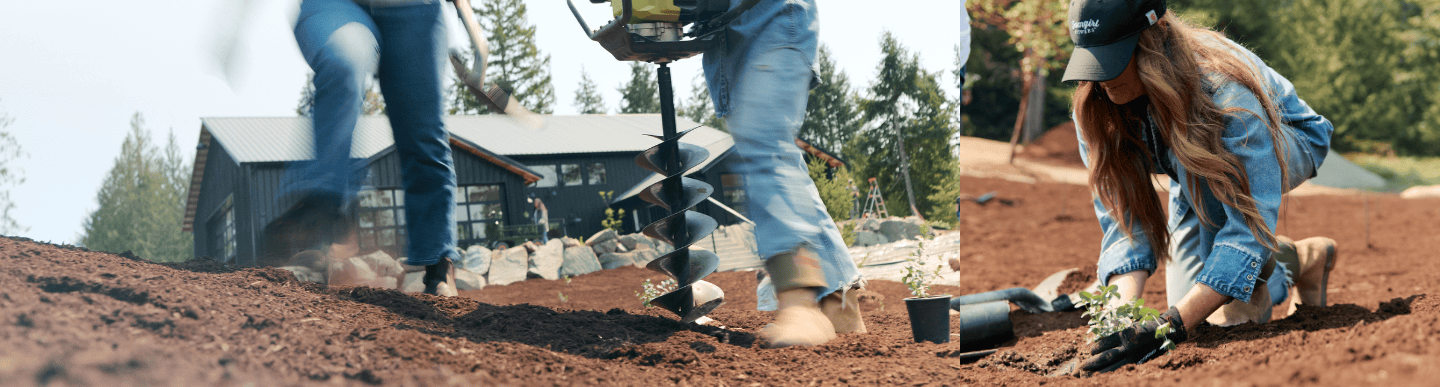
Plants that will get bigger. Some will bloom. Some will probably die, because I am a gardener and therefore contractually obligated to kill a percentage of everything I plant. Some we'll move because I inevitably decide I put them in the wrong place (like our test eucalyptus that is already about fifteen feet tall two years in, and unfortunately about two feet from the office). And hopefully a whole lot of them will still be growing there many anniversaries from now.
And I really can't think of a better gift.
So by all means, look up your traditional anniversary flower. Use the chart. Learn the meaning. Let it give you an idea. Then think about your person.
Because the best anniversary flowers aren't necessarily the ones someone assigned to your year. They're the ones that say: I know you. And after one whole year of marriage, I may not be qualified to give much marriage advice yet.
But that part? That part I feel pretty good about.
Anniversary Flowers by Year: Quick FAQs
What is the traditional flower for a first wedding anniversary?
The traditional first wedding anniversary flower is the carnation, commonly associated with young love, affection and devotion. Carnations have been unfairly typecast as filler flowers, but the right varieties can be truly beautiful. Still, if they aren’t your partner’s favorite, choose something they actually love instead. If you’re still figuring out their favorites this early on, we recommend tulips — they’re economical while looking anything but.
What is the traditional flower for a 5th wedding anniversary?
The traditional fifth wedding anniversary flower is the daisy, which is associated with loyal love, happiness and cheerfulness. Daisies are hard not to like, but for an anniversary gift, we prefer gerbera daisies. They have the same happy energy in a bolder, longer-lasting form, and they’re available year-round — which is helpful since anniversaries refuse to schedule themselves around flower seasons.
What is the traditional flower for a 7th wedding anniversary?
The traditional seventh wedding anniversary flower is freesia, associated with trust and lasting friendship. Freesia smells wonderful, but it’s one of those flowers that knows it’s better as part of a team. We wouldn’t ask it to carry an entire arrangement by itself, so anemones are our pick if you want one flower to be the star. Thanks to growers in the Ecuadorian highlands, anemones are now available year-round instead of only during their traditional winter season.
What is the traditional flower for a 10th wedding anniversary?
The traditional tenth wedding anniversary flower is the daffodil, often associated with joy, renewal and new beginnings. Daffodils are beautiful, but their season is brief, so don’t be afraid to choose something else if your anniversary doesn’t happen to fall in spring. Our upgrade is Hanoi ranunculus, with layers upon layers of blush petals that make it look like you understood this was a big one.
What is the traditional flower for a 15th wedding anniversary?
The traditional fifteenth wedding anniversary flower is the rose. Red roses are the classic romantic choice, but garden roses or roses in your partner’s favorite color will make the gift feel much more personal. Fifteen years in, the goal isn’t to prove that you know the anniversary flower chart — it’s to prove that you know your person.
What is the traditional flower for a 20th wedding anniversary?
The traditional twentieth wedding anniversary flower is the aster, which symbolizes love, patience and wisdom — all three of which you’ve probably earned after two decades of marriage. Asters are more of a garden flower than a cut flower, so our pick is peonies — which 92% of our customers named as their favorite flower when we surveyed them, so there’s a very good chance they’re your partner’s too.
What is the traditional flower for a 25th wedding anniversary?
The traditional twenty-fifth wedding anniversary flower is the iris. The 25th is also known as the silver anniversary, which is lovely in theory but slightly less helpful when you’re trying to order flowers. Our pick is the cymbidium orchid: elegant, long-lasting and appropriately special for a quarter-century together. Cymbidiums are typically available from October through May.
What is the traditional flower for a 30th wedding anniversary?
The traditional thirtieth wedding anniversary flower is the lily. For a milestone this big, we recommend upgrading to double lilies. They have twice the petals, no pollen and blooms that continue opening for about a week. You get all the impact without orange pollen dropping onto the tablecloth, which may be one of the more romantic upgrades on this entire list.
What is the traditional flower for a 40th wedding anniversary?
The traditional fortieth wedding anniversary flower is the gladiolus, associated with strength and integrity. Gladiolus is striking, but our pick is protea: bold, architectural and available nearly year-round. Protea also looks like it could survive just about anything, which feels like extremely appropriate energy for 40 years of marriage.
What flowers are traditional for a 50th wedding anniversary?
The traditional flowers for a fiftieth, or golden, wedding anniversary are yellow roses and violets. Violets are charming but not exactly built to carry a delivered bouquet, so this is one of those years when tradition requires a little flexibility. After 50 years together, we strongly support choosing any flower that carries special meaning in your relationship. If you’re not sure, our pick is garden roses in butter and gold, with approximately a zillion ruffled petals — one for every wonderful year you’ve shared, with plenty left for whatever comes next.
What flowers are available year-round?
Roses, garden roses, spray roses, lilies, sunflowers, hydrangeas, carnations, chrysanthemums, gerbera daisies, calla lilies, lisianthus, snapdragons, stock, anemones, ranunculus, anthurium and protea are available essentially year-round. Anemones and ranunculus were winter-only flowers until growers in the Ecuadorian highlands began producing them at altitude on the equator. Tulips and cymbidium orchids have long seasons but are not year-round — they run roughly October through May and largely disappear over the summer. Peonies, dahlias, delphinium, lilac, lily of the valley, daffodils, cosmos and bearded iris are true seasonal flowers, so check availability before you build a gift around one.
What if my anniversary flower isn't in season?
Choose a different flower, and don’t worry, your partner will still love them, promise! Several of the traditional anniversary flowers have very short seasons, so if yours isn't available when your anniversary falls, substitute something from the year-round list above, or simply send whatever is at its seasonal peak that week. A flower in its true season is generally better quality and better value than the same flower shipped in from the other hemisphere. Kind of like produce, just prettier!
Is there an anniversary flower for every year?
Not quite. The traditional list assigns a flower to each year from the first through the fifteenth, then moves to milestone years — the twentieth, twenty-fifth, thirtieth, thirty-fifth, fortieth, forty-fifth and fiftieth. Sources also disagree in places, so you'll find more than one "official" answer for some years.
Are red roses the best anniversary flowers?
Only if the person receiving them loves red roses. Roses are a classic symbol of romantic love, but the best anniversary flowers are the ones chosen with the recipient in mind. Wedding flowers, a favorite variety or a flower connected to a shared memory can feel much more romantic than automatically choosing red roses.
What flowers should I send for an anniversary if I don't know their favorite?
Start with our anniversary flowers and choose something that feels like the person you're celebrating. If you want something especially romantic, I'm partial to specialty garden roses. They're big, ruffly, fragrant and feel a little more special than your standard rose — which is exactly what an anniversary calls for.