


The 2026 Flower Trends Report
The 2026 Flower Trends Report
What Farmgirl Flowers Orders Reveal
Flower trends in 2026 have a clear headline: peonies are America's runaway favorite but buyers increasingly want them professionally designed rather than DIY or a single-varietal bouquet, and the gifts themselves logged 94 million miles carrying the words "love you" across the country. This report is built on Farmgirl Flowers' own first-party data — every stat below comes from real orders placed January 1 through June 30, 2026, compared with the same period in 2025, plus two studies of the people doing the sending and receiving.
Here's the half-year in numbers, based on Farmgirl Flowers orders:
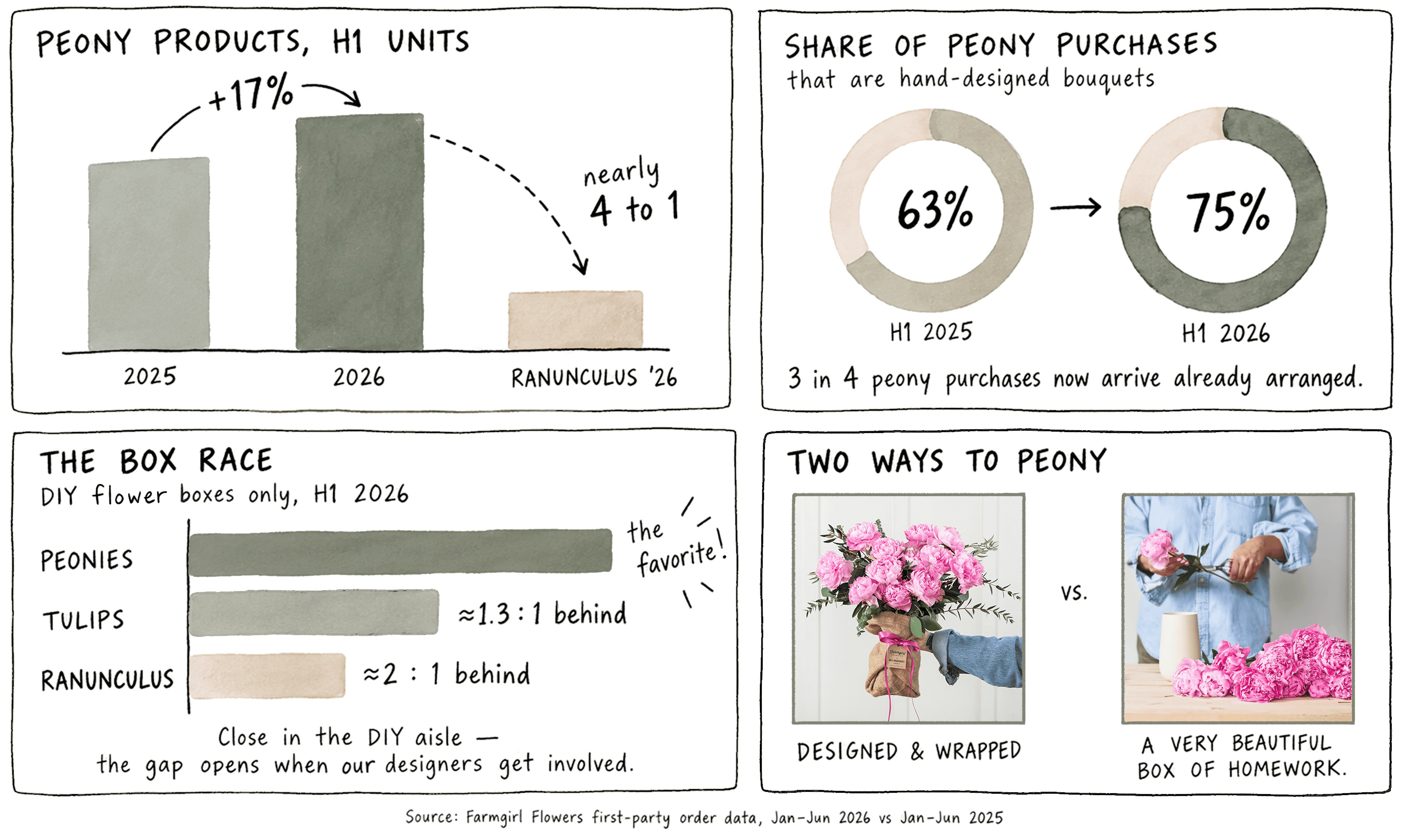
- Peony product units grew 17% year over year, outselling every other flower except roses and outselling ranunculus nearly 4 to 1 — and 3 in 4 peony purchases were hand-designed bouquets, up from about 3 in 5.
- Tulip product units grew 54% year over year.
- Nearly one in three Valentine's week orders was placed within the final three days before February 14 — even though only 11% of women say they want flowers to arrive on the day itself, per Farmgirl's recipient study.
- Only 2.5% would choose red roses for themselves.
- Easter held its full strength despite falling three weeks earlier than last year — and "bunny" mentions in card messages nearly tripled.
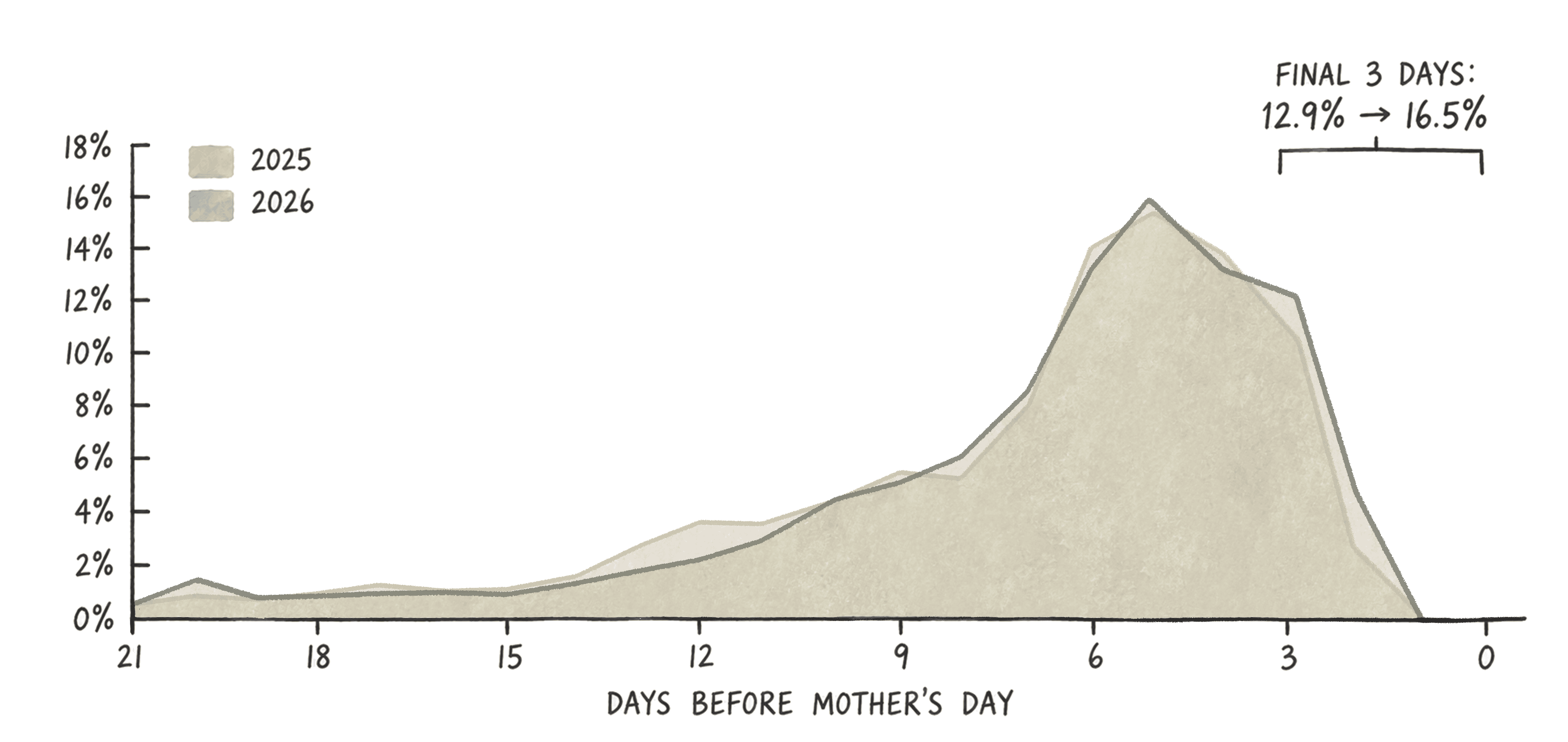
- Mother's Day shoppers ordered later than ever: 16.5% of holiday-week orders came in during the final three days, up from 12.9%, and last-possible-day orders nearly doubled as a share.
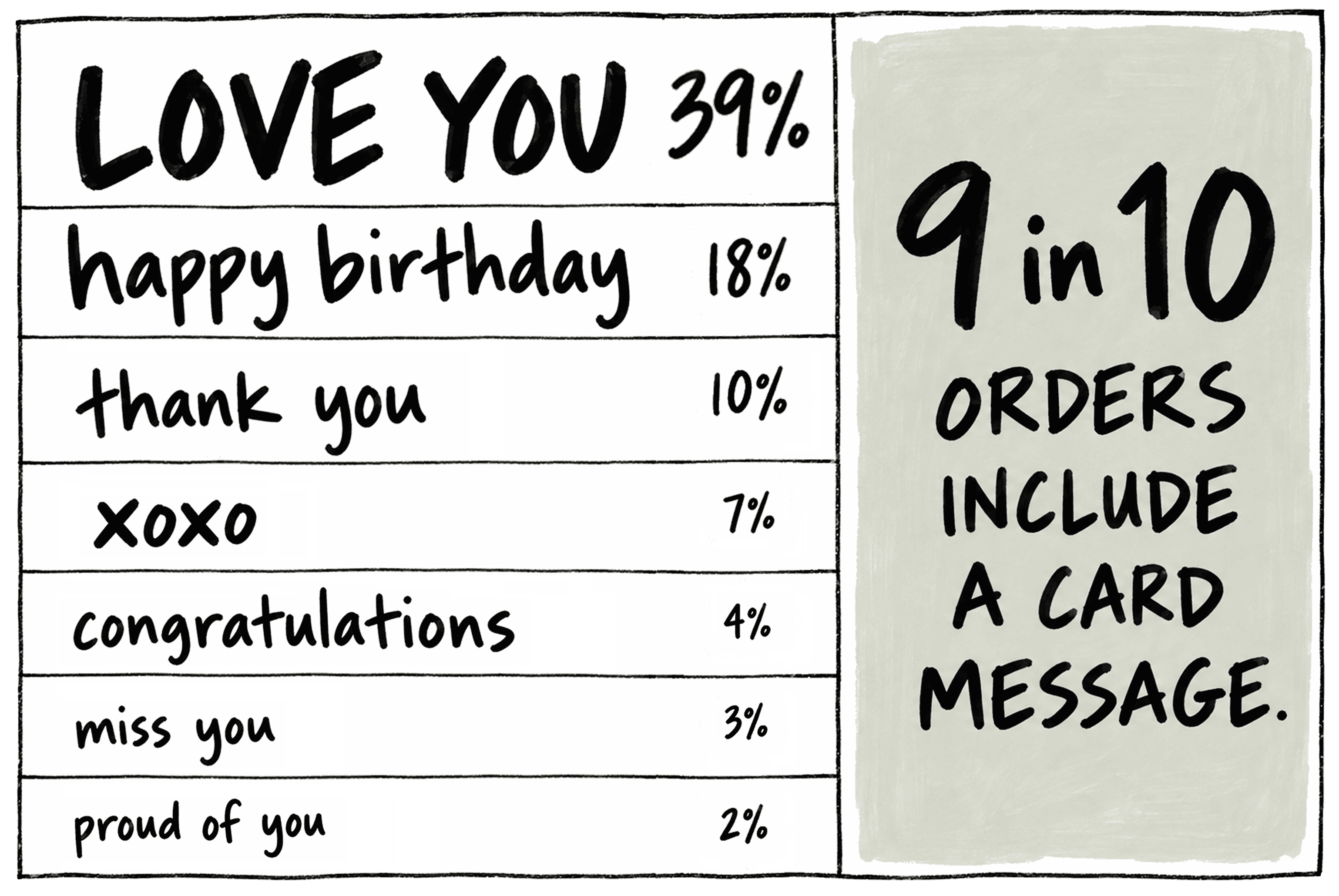
- Roughly 9 in 10 orders ship with a card message, and nearly 4 in 10 of those messages contain the words "love you."
- Farmgirl gifts traveled a combined 94 million miles between senders and recipients in the first half — nearly 3,800 trips around the Earth, measured between sender and recipient ZIP areas. California-to-Texas was America's busiest flower route.
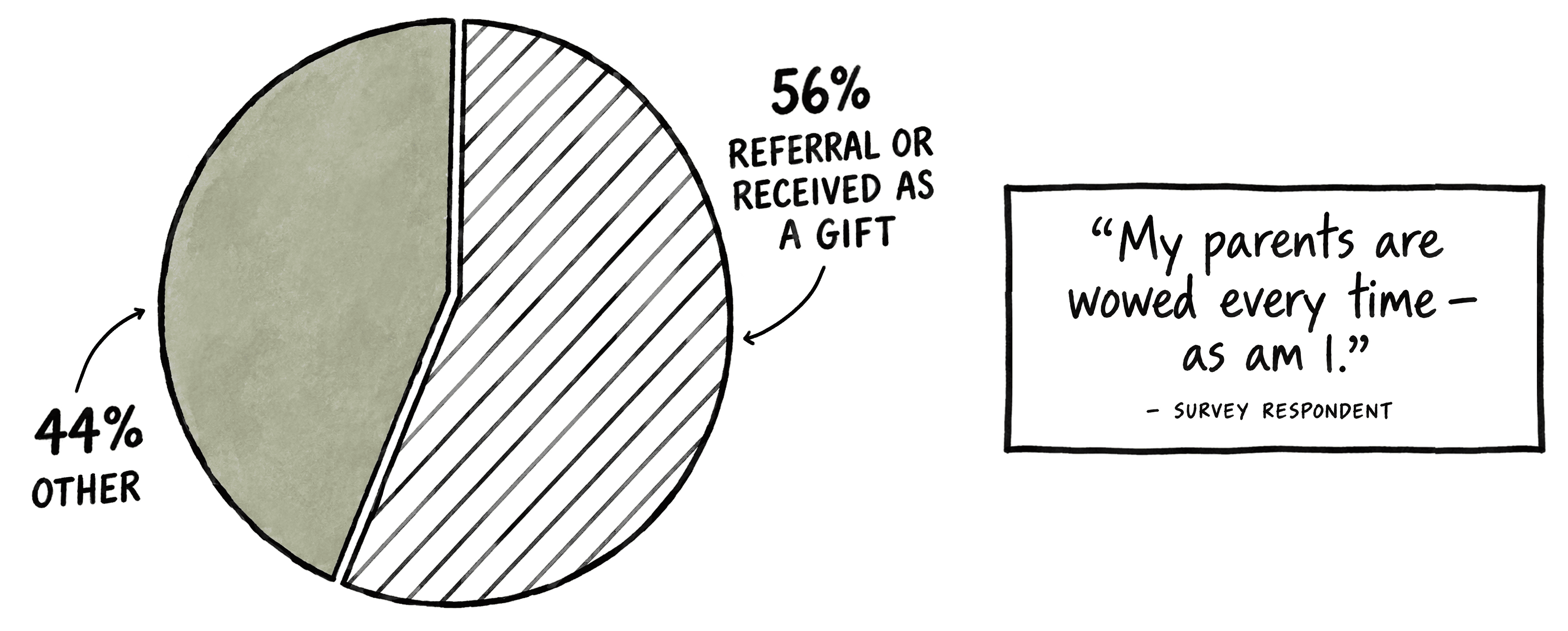
- About 1 in 6 orders ships to the buyer's own address, and 56% of Farmgirl's most loyal customers first found the company through a friend or by receiving a bouquet — the recipients become the senders.
The rest of this report unpacks each trend — what Americans bought at Farmgirl, when, for whom, and how far it traveled.
In this report:
- A half-year of holidays, in order
- Peonies: America's favorite flower — now professionally arranged
- What 150,000 card messages tell us
- The geography of gifting: 94 million miles of "thinking of you"
- When our customers shop for flowers
- Meet the great gifters
- New from the design team
- Flowers for your house: The Albertsons Companies partnership grows this fall
- Postcard from the Farmquarters: Designing Christmas in July
- Flower trends 2026: FAQ
About the data
*Journalists, researchers, and fellow flower nerds: you're welcome to cite any figure in this report with attribution and a link to Farmgirl Flowers. For questions about the data or methodology, contact us.*
A half-year of holidays, in order
Valentine's Day: later, fancier, and not that into red roses
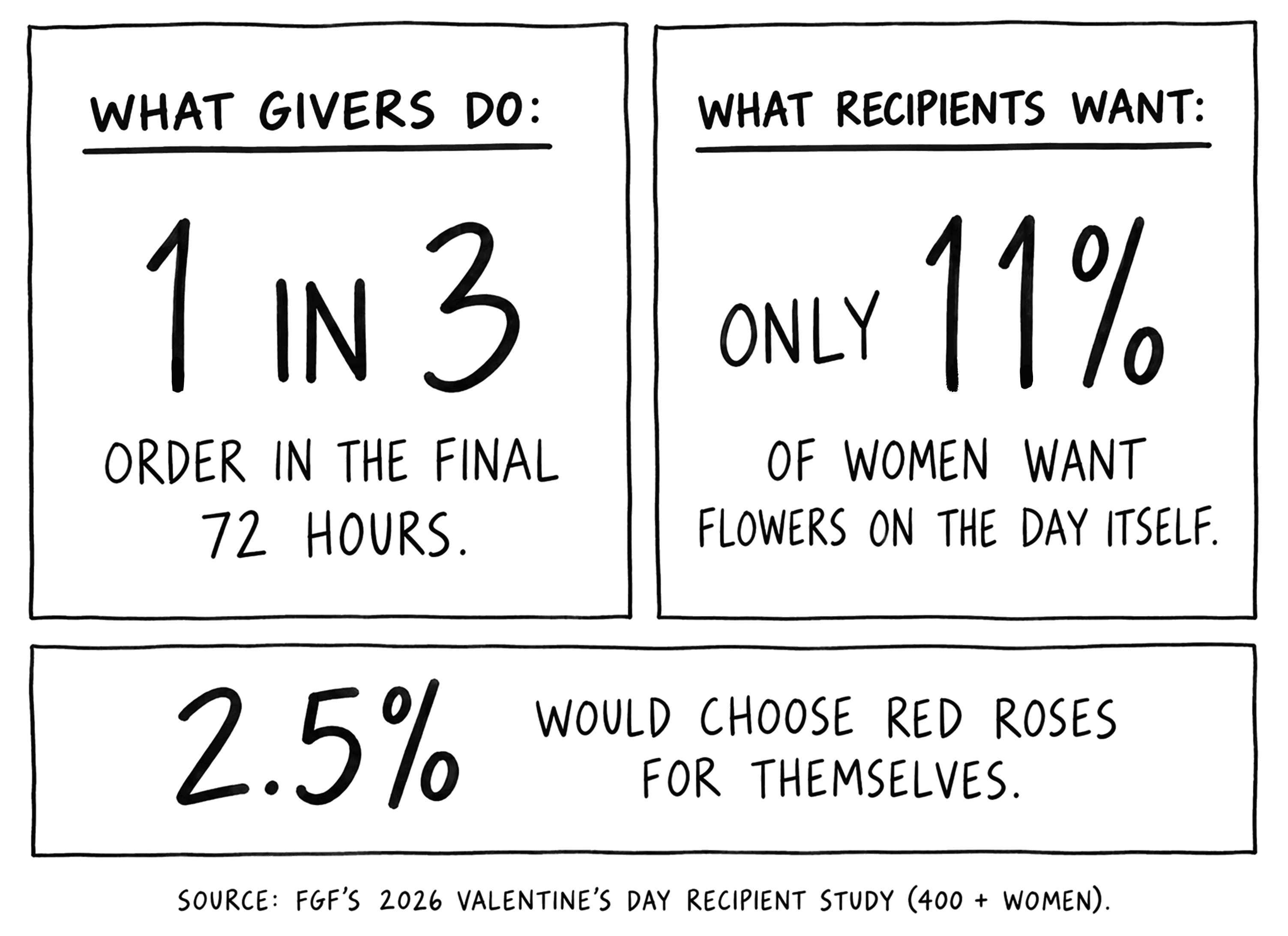
Valentine's shoppers are the flower world's most reliable procrastinators: nearly one in three Valentine's week orders — 32.2% in 2026, 33.2% in 2025 — comes in during the final three days before February 14. The twist this year: they traded up, spending about 11% more per order than in 2025. Later, but fancier.
Here's the thing, though — this January, we asked the other side of the transaction what they actually want. Valentine's Day is the one week of the year when the flow of flowers reverses: most of the year, women send flowers to women, but in February, men gifting women take over the order queue. Which is exactly why Farmgirl's 2026 Valentine's Day study surveyed 400+ women — answering as recipients, not shoppers — and the findings should be pinned above every gift-giver's desk:
• Only 11% prefer receiving Valentine's flowers on February 14 itself. Respondents mentioned that flowers on Friday (ahead of this year’s Valentine’s Day, which fell on Saturday) feel planned; flowers on the day feel like a deadline met. Set against the third of buyers ordering in the final 72 hours, that's the timing gap: givers optimize for the deadline, recipients optimize for the runway.
• Only 2.5% would choose red roses for themselves — even though about 1 in 10 genuinely loves them. Red roses didn't win Valentine's Day; they defaulted into it. The order data agrees: classic roses were roughly flat this year while ruffled, garden-style stems surged. What recipients say they want and what's growing fastest turn out to be the same thing — something that feels designed, unexpected, or personal.
• The preferences barely change by age. From Gen Z to Gen X and beyond: attention beats tradition, intentionality beats bouquet size, and the flowers should feel like the recipient — not like the calendar.
Easter: the holiday we can never predict (and love anyway)
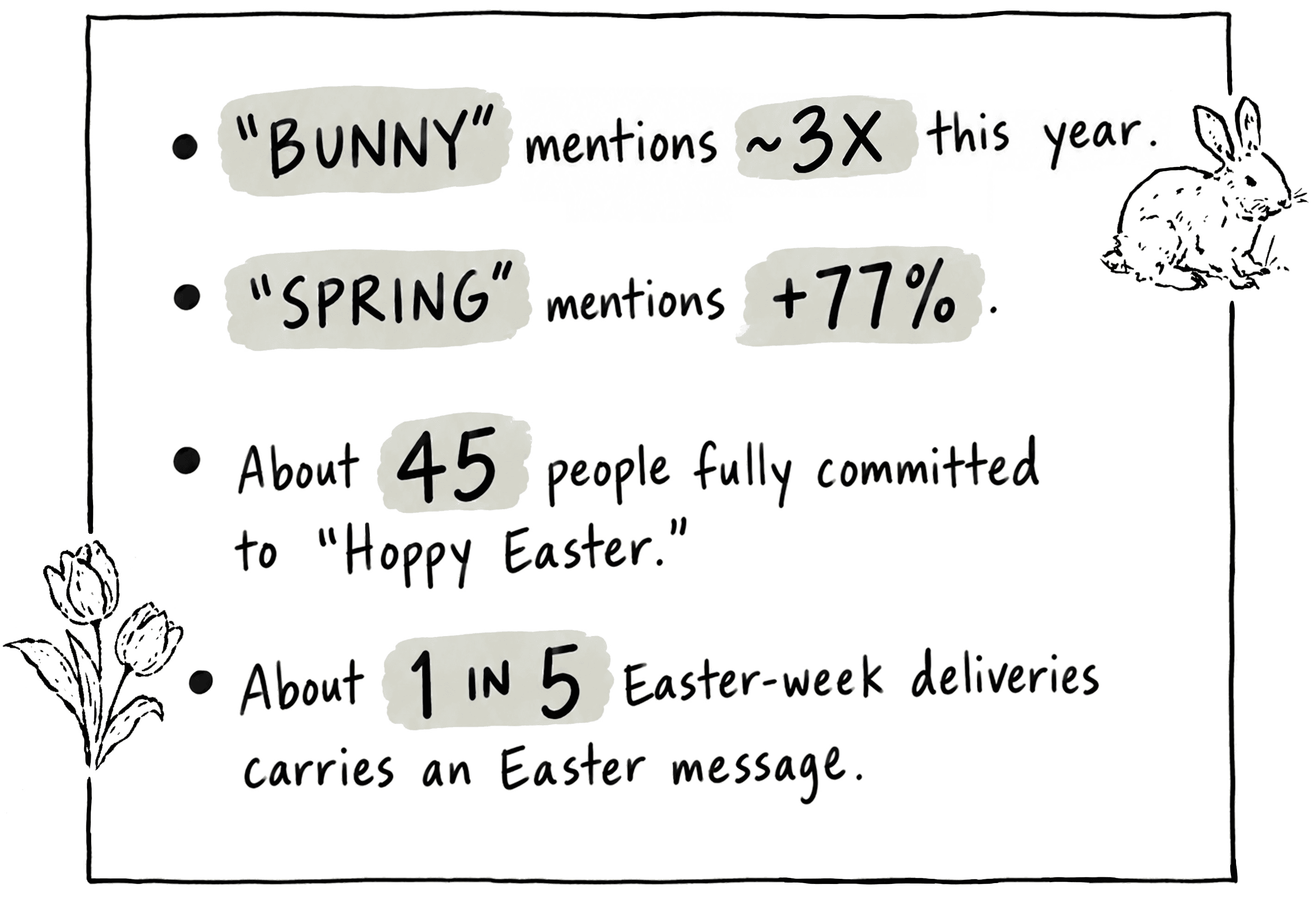
Easter is the one flower holiday that refuses to be forecast — it wanders the calendar, and this year it wandered three weeks earlier, landing on April 5. By rights, an earlier Easter should soften flower sales. Instead, Easter refused to shrink: orders carrying an Easter card message actually ticked up over last year — about one in five deliveries that week — even with three fewer weeks of spring to work with.
And what messages. "Bunny" mentions in Easter-week cards nearly tripled this year, "spring" mentions rose 77%, and — we counted — about 45 people per year commit fully to "Hoppy Easter." We love a pun, and if you’re looking for what to write in your next Easter card, here are some additional options for next year:
Easter card message ideas:
- "Happy Easter to my sweet peeps! We love you eggs-actly as you are cuz no bunny compares to you!!! ;)" — the triple crown: peeps, eggs-actly, AND no bunny in one card.
- "Hoppy Spreaster!!!!" — hoppy + spring + Easter in a single invented word. Poet laureate material.
- "Hop hop hopping some love — where da carrots?" — signed, naturally, as the bunny.
- "Somebunny loves you!" — the classic, and this year's most-repeated pun format.
- "Happy Easter granny — love, all your peeps" — "peeps" doing double duty.
- "Hoppy Easter…egg!" — commitment to the bit, ellipsis included.
- "Love & hugs from the East Coast Easter Bunny" — apparently the Bunny has regional franchises.
- "Hoppy new home to you!" — the pun escapes Easter entirely: housewarming edition.
- "Happy snappy hippy hoppy birthday!" — Easter-week birthday, maximum rhyme.
The timing is almost unfair: Easter lands mid-spring-bulb season, when Farmgirl's tulips come in more colors than a candy shop and we see daffodils and hyacinths bring the perfect color palette to any brunch. Not to mention, domestic ranunculus season is in full swing. So really this is prime time for this and any holiday.
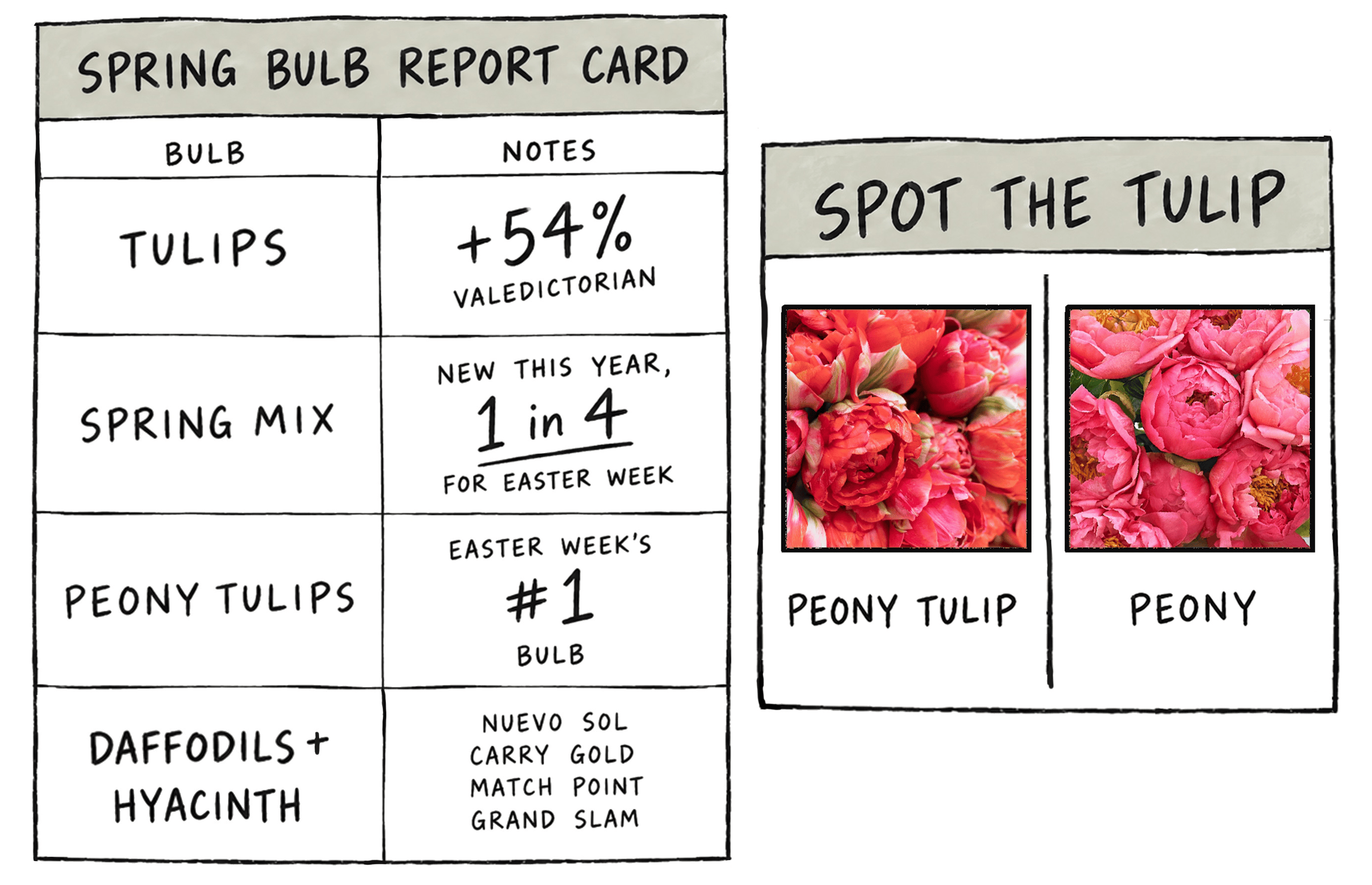
And then you have Easter lilies. Lilies are the traditional Easter flower, and the tradition is real — in 2025, Farmgirl's Easter bouquet was literally a lily design named Hoppy Medium, and a third of its season sold in Easter week alone. But in 2026, America voted for color: peony tulips and Spring Mix (a mix of daffodils, tulips and hyacinth) out-delivered every lily product during Easter week. We know the Easter lily isn't gone. It just got out-tuliped this year.
Looking at what share of each state's Easter-week deliveries actually carried an Easter message — i.e., which state was most Easter-y about its flowers — Florida leads at 28.8%, with Pennsylvania in a photo finish at 28.6%. Nearly 3 in 10 bouquets delivered in Florida that week said Happy Easter, roughly double the rate of California (16.1%), Washington (15.9%), or Illinois (15.3%). Ohio (23.4%) and Arizona (24.7%) also over-index.
The spring bulb report
Easter is the peak around early spring, but bulbs carry the whole season at Farmgirl — and in 2026, tulips carried the bulbs. Tulip units grew 54% year over year, and the lineup grew with them: classically Dutch stems by the 30 and 50, white tulips, French tulips, peachy pinks, and confetti-toned mixes, alongside daffodils shipping 50 and 100 stems at a time and a colorful hyacinth lineup.
One clarification, because the question comes up every year: peony tulips are tulips, not peonies. They're double late tulips — extra-ruffled varieties that open wide enough to impersonate a peony — and in 2026 they were the single biggest bulb line of Easter week. If peonies are the flower of the year, peony tulips are how spring gets a head start on them.
The newest thing in the bulb lineup is also the simplest: Spring Mix, a 2026 box that combines daffodils, tulips, and hyacinth in one delivery. About 1 in 4 of them shipped for Easter week. Sometimes the trend is just "all of spring at once, please."
Mother's Day: everyone is ordering later (yes, even for Mom)
Mother's Day shoppers ordered later in 2026 than in 2025 — by every measure Farmgirl tracks. In 2026, 16.5% of Mother's Day week orders were placed in the final three days before the holiday, up from 12.9% in 2025. Orders placed on the last possible ordering day nearly doubled as a share of holiday volume, from 2.4% to 4.5%.
We're not judging. (We're a little judging. Lovingly.) But the trend line is unambiguous: whatever the occasion, the average flower order now lands just over seven days before the big day, and it points later every year.
The takeaway for gift-givers: the calendar on each product page shows real-time delivery availability, and dates for peak holidays genuinely do sell through. Ordering early doesn't just lower your heart rate — it gets you first pick of the menu.
Now let’s talk about product. The strategy this year had one word in it, three times: Peonies. For the past two years, North American peony season has been kind enough to overlap with Mother's Day — a lucky accident of botany we decided to stop treating as luck. The 2026 plan, as Christina put it in a video that spring, was simple: peonies, peonies, peonies. They showed up in every format we make — hand-designed burlap-wrapped bouquets, stems by the bunch, and bunches of 50 for the truly beloved moms (best gift ever, if you ask us). And our customers agreed: more than half of everything delivered during Mother's Day week — 54%, up from 49% the year before — had peonies in it.
And who's getting all these peonies? Not just moms. Nearly 9 in 10 Mother's Day week card messages mention Mom, Mother, or Mama — but read closer and Mother's Day turns out to be Motherhood Day. Thousands of bouquets went to grandmothers, addressed to every version of her: Grandma, Nana, Gigi, Mimi, Abuela. Hundreds more went to aunts, bonus moms, stepmoms, mothers-in-law, and godmothers. Some marked someone's very first Mother's Day. And a small, sincere handful went to dog moms, cat moms, and — we checked twice — plant moms. Motherhood has a lot of job titles, and flowers work for all of them.
Here's the last fun fact the data told us: Mother's Day cards are the shortest of the year. The average card message runs about 118 characters. Mother's Day week? 104 — the most concise notes written all year. We don't think it's because people have less to say to their moms. We think it's because they don't need the card to say it: "Love you, Mom. Happy Mother's Day." lands complete in a way no other card does — and besides, she's getting a phone call on Sunday anyway. The flowers handle the rest.
Peonies: America's favorite flower — now professionally arranged
Roses aside, peonies are the most popular flower at Farmgirl Flowers in 2026, and it isn't close. Peony product units grew 17% year over year in the first half — outselling the next most popular flower, ranunculus, nearly 4 to 1. And that's no knock on ranunculus, which grew 27% itself this year. Peonies just lapped it.
(Why "roses aside"? Because roses are less a trend than a load-bearing wall: they appear in a huge share of our mixed bouquets as part of the ensemble, but they rarely get the marquee. This ranking counts headliners — the flower a product is actually about.)
Here's the part we find genuinely interesting: where the peony race is closest is the one place you'd expect peonies to dominate — the DIY flower box. Compare boxes to boxes, flower to flower, and it's a real contest: peonies are still America's favorite box, but tulips run a close second and ranunculus holds a strong third. Roughly one in four DIY flower boxes sold in the first half was a peony box, and the two best-selling flower boxes of 2026 so far are both pink peony boxes — Perfect 10: 10 Pink Peonies! and Twenty, Twenty: 20 Pink Peonies!. Respectable. Beloved, even. But not a landslide.
The landslide happens the moment our designers get involved. Hand-designed, burlap-wrapped peony bouquets grew 39% year over year, and designed bouquets now make up 75% of all peony purchases, up from 63% last year. DIY peony boxes went the other direction — buyers who used to arrange their own increasingly handed the job to us. That designed surge is what stretches a close box race into a 4-to-1 rout: customers don't just want peonies; they want peonies arranged.
Our read: peonies got famous, and then people discovered what florists have always known — a great flower and a great bouquet are two different skills. When the stems are this good, more buyers want them arriving already designed, wrapped, and camera-ready, rather than as a box of homework. (A very beautiful box of homework. But still.)
Peonies aren't the only riser. Here's how flower-named products moved year over year, based on Farmgirl orders:
What 150,000 card messages tell us
Roughly 9 in 10 Farmgirl orders ship with a card message, and in the first half of 2026 that added up to more than 150,000 notes. Classified by what they actually say (in aggregate — we're florists, not snoops), based on Farmgirl orders:
- "Love you" was the most-written phrase — nearly 4 in 10 card messages contain it. About 1 in 12 goes fully declarative with "I love you."
- "Happy birthday" appears in nearly 1 in 5 messages, making birthdays the biggest everyday reason our customers send flowers — about 1 in 3 of all January deliveries. Friday and Tuesday are neck and neck as the top birthday delivery days (~24% each).
- Gratitude runs through everything: "thank you" appears in 1 in 10 messages, and "xoxo" seals about 7% of them. "Congratulations" and "miss you" each show up a few times in every hundred cards, and roughly 2% of senders write "proud of you" — thousands of people who decided that one deserved ink, not a text.
- No canned message dominates. Across 150,000+ messages, no single exact message repeats at any real scale — even "Happy Birthday!" almost always arrives with a personal twist. People don't send flowers generically.
Two spending patterns stood out: anniversary senders spend the most of any named occasion — and up roughly 5% this year — and the highest average order of all belongs to orders with no card message, often people buying for their own homes.
Where love is the loudest
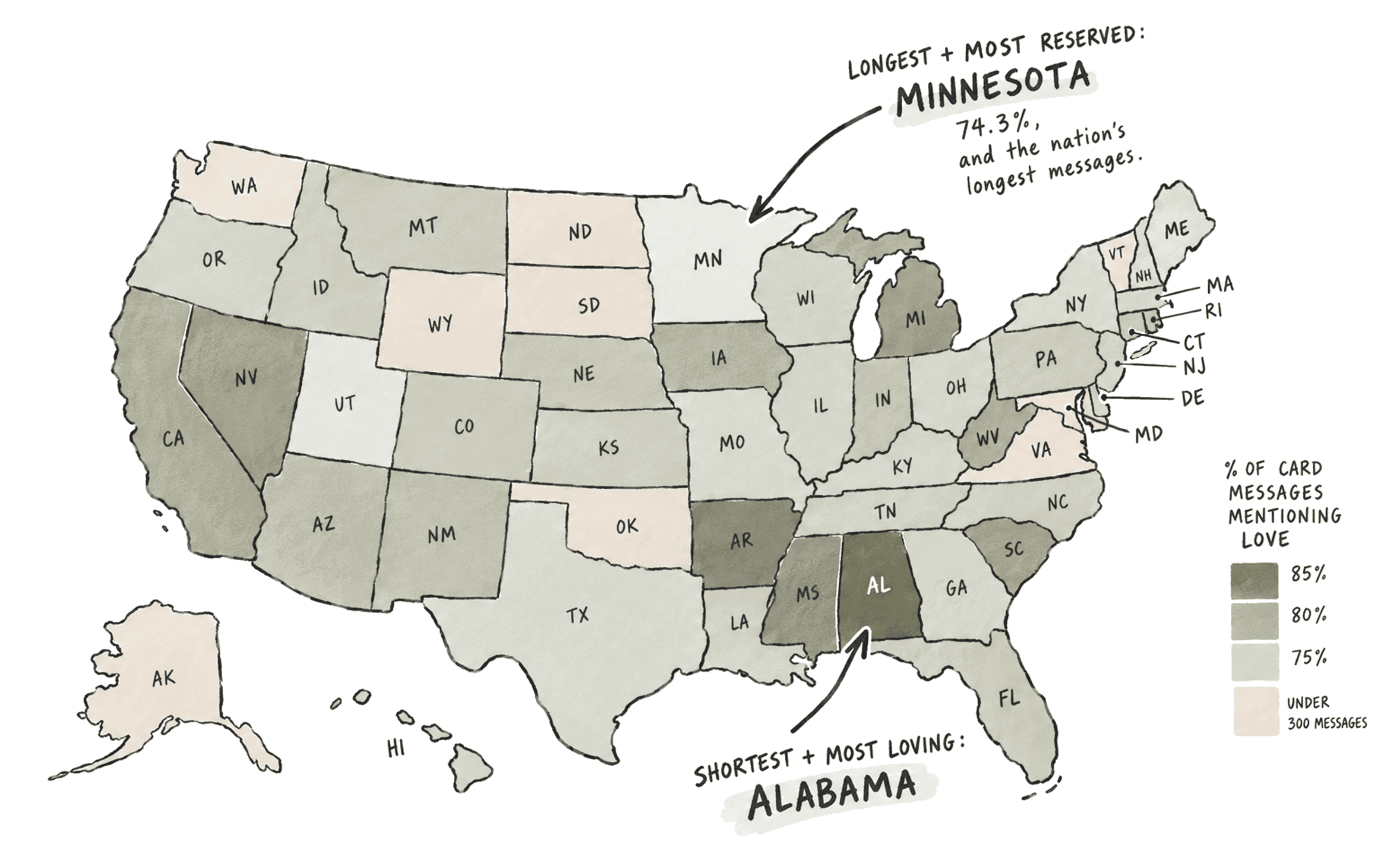
Break the messages down by sender state and a map of American affection emerges. Alabama is the most loving state in the country — 84.4% of card messages sent from Alabama mention love — and the South sweeps the podium, with Tennessee (82.8%) and South Carolina (81.5%) right behind.
But before anyone starts a regional rivalry: in every qualifying state, at least 3 in 4 messages mention love. Nobody in America is phoning it in.
The fun inversion is Minnesota. Minnesotans mention love the least often of any qualifying state (74.2%) — and write the longest card messages in the country, averaging 127 characters to Alabama's brisk 108. Alabama says it fast; Minnesota writes you a letter. Different love languages, same bouquet.
October is for birthdays
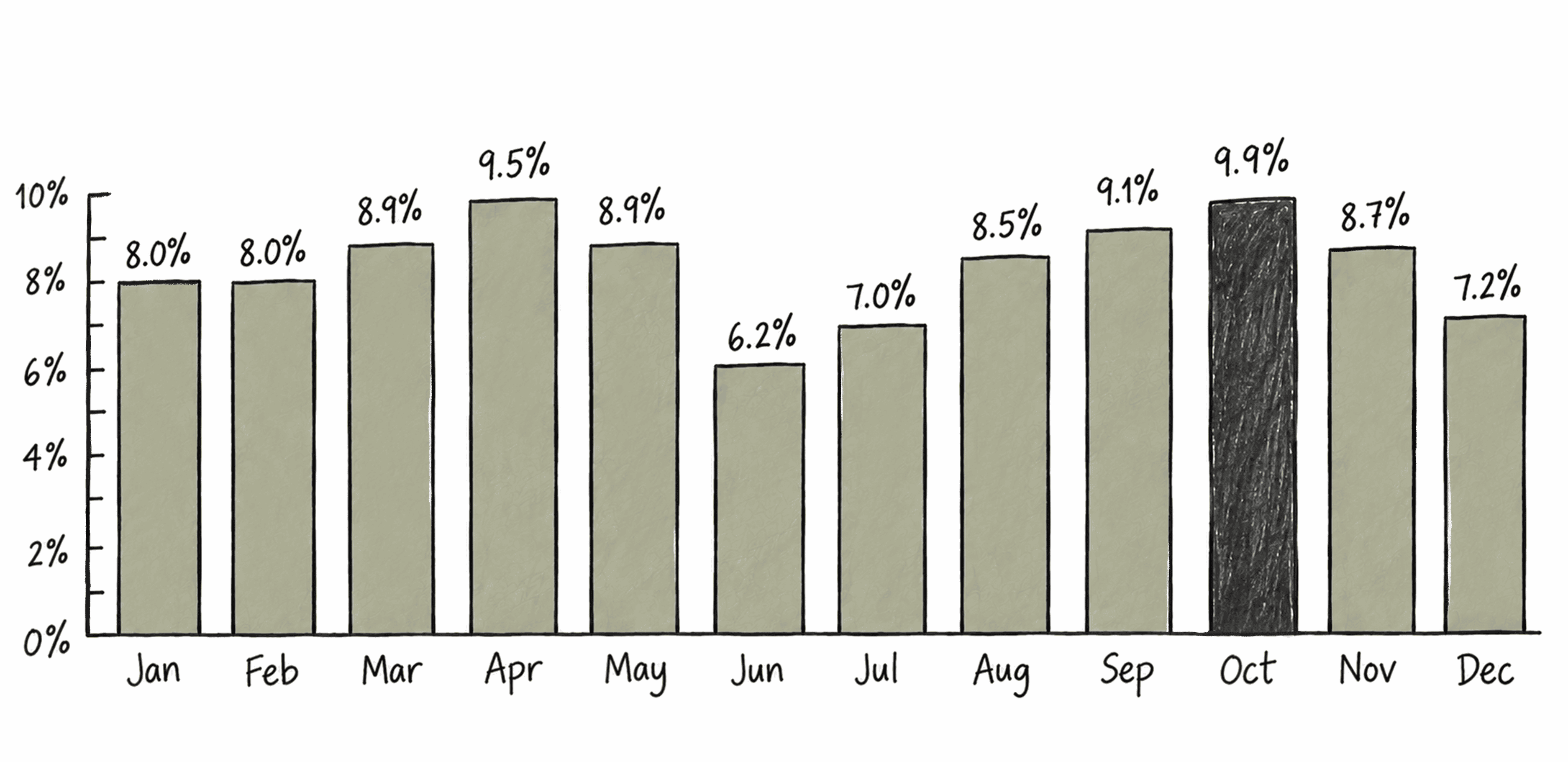
One more thing the messages revealed: birthday flowers have a season, and the first half of the year already sketches its shape. April was the biggest birthday-flower month of H1 — and June, ironically the month when the most flowers are in bloom, was the quietest of all. (This is also the strongest evidence yet for our petition to relocate Mother's Day to June. The flowers are ready. The calendar is not.)
But the year's true birthday peak arrives just after this report closes: October. And here's the part that surprised us — according to U.S. birth records, September is actually America's most common birth month. Not at Farmgirl. More birthday bouquets are delivered for October birthdays than for any other month of the year, September included. Whether that means our customers simply skew autumnal or September babies get shortchanged by back-to-school season, we can't say — but if you love an October baby, consider this your officially early reminder. And if you're wondering what flower goes with an October birthday — or any month — we wrote a whole guide to birth flowers by month.
The quiet job flowers do
Not everything in this report is a celebration, because not every bouquet is. White flowers are the traditional choice for sympathy in America — peace, remembrance, and calm in petal form — and the card messages confirm the tradition is alive: in the first half of 2026, Farmgirl's all-white designs carried a sympathy message four to five times as often as its most colorful bouquets.
We don't take that lightly. When someone sends white flowers with a two-line card, they're trusting us with one of the hardest deliveries there is — and it's part of why those designs stay in the lineup year-round, no holiday required. If you're choosing flowers for a loss and don't know where to start: white or soft, simple, and on time is always right. And if the card is the part you're stuck on, we wrote a gentle guide to what to write in a sympathy card. The rest, the flowers say for you.
Sympathy and condolence flowers →
The geography of gifting: 94 million miles of "thinking of you"
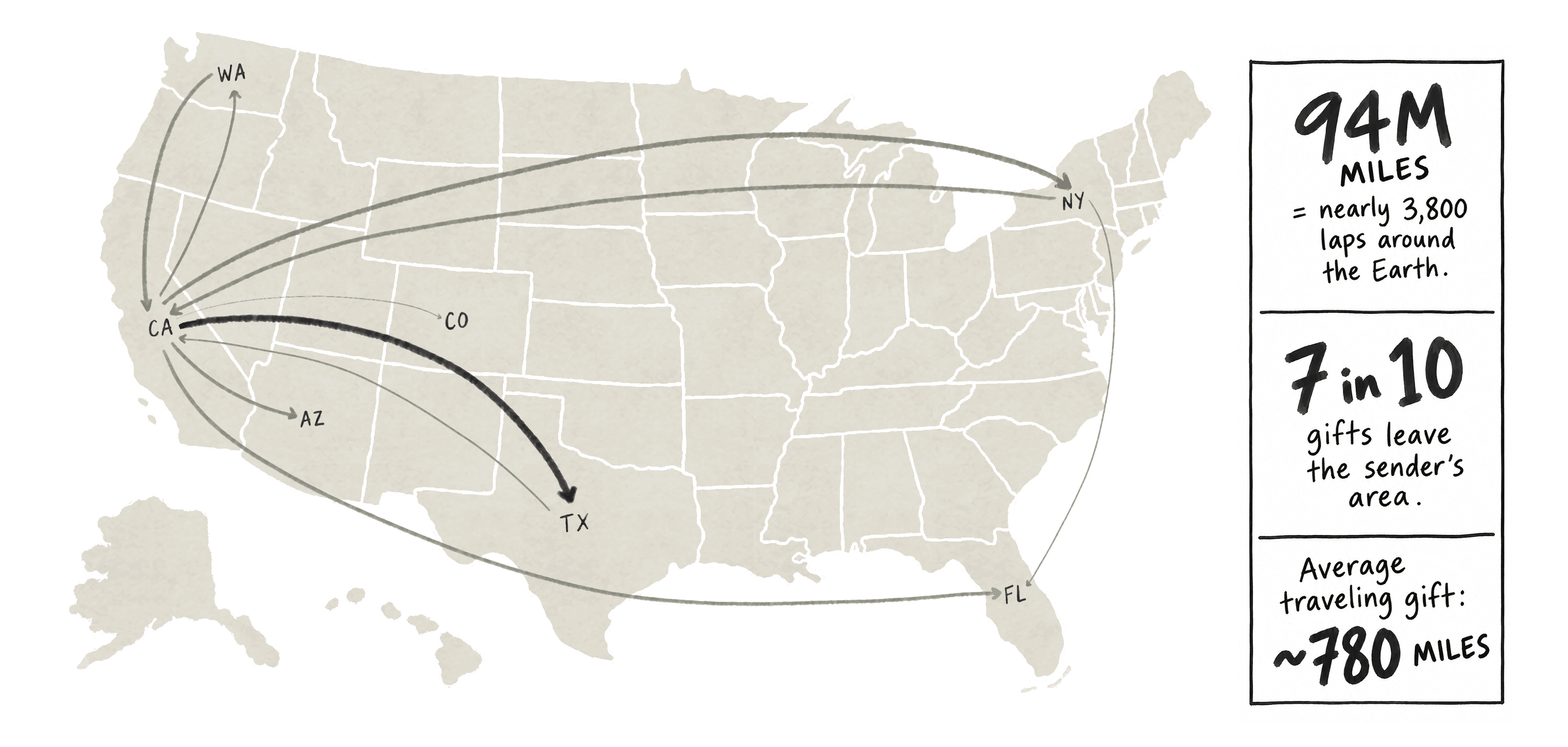
Seven in ten Farmgirl orders leave the sender's own area entirely, and half cross state lines. In the first half of 2026, the journeys between senders and recipients added up to a combined 94 million miles, measured between sender and recipient ZIP areas — nearly 3,800 trips around the Earth, with the average traveling gift covering about 780 miles. When we say flowers close the distance, we can now put a number on the distance.
One thing those miles are not: the odometer on your bouquet. The 94 million measures the distance between the two people — how far apart the sender and the recipient live — not the route the flowers take. The flowers themselves travel a much shorter, faster, colder path: farm-fresh stems ship from the hub nearest your recipient, so a bouquet "sent" from California to a sister in New York isn't riding across the country in a box. Your love makes the 2,800-mile trip. The flowers just meet it there, fresh.
The busiest routes tell their own story, based on Farmgirl orders:
- California → Texas: America's #1 flower route: the friend who moved away
- California ↔ New York: The biggest two-way corridor.
- Washington → California: Down the I-5 with love
- New York → Florida: Adult children to retired parents, we'd wager
- California → Arizona, Colorado, Oregon: The California diaspora, keeping in touch
California is the sun this whole system orbits: it appears on one end or the other of 12 of the 15 busiest cross-state routes, and it receives more deliveries than any other state, followed by Florida, Texas, and New York. Farmgirl ships nationwide across the lower 48 — check delivery availability for any address with the calendar on each product page.
When our customers shop for flowers
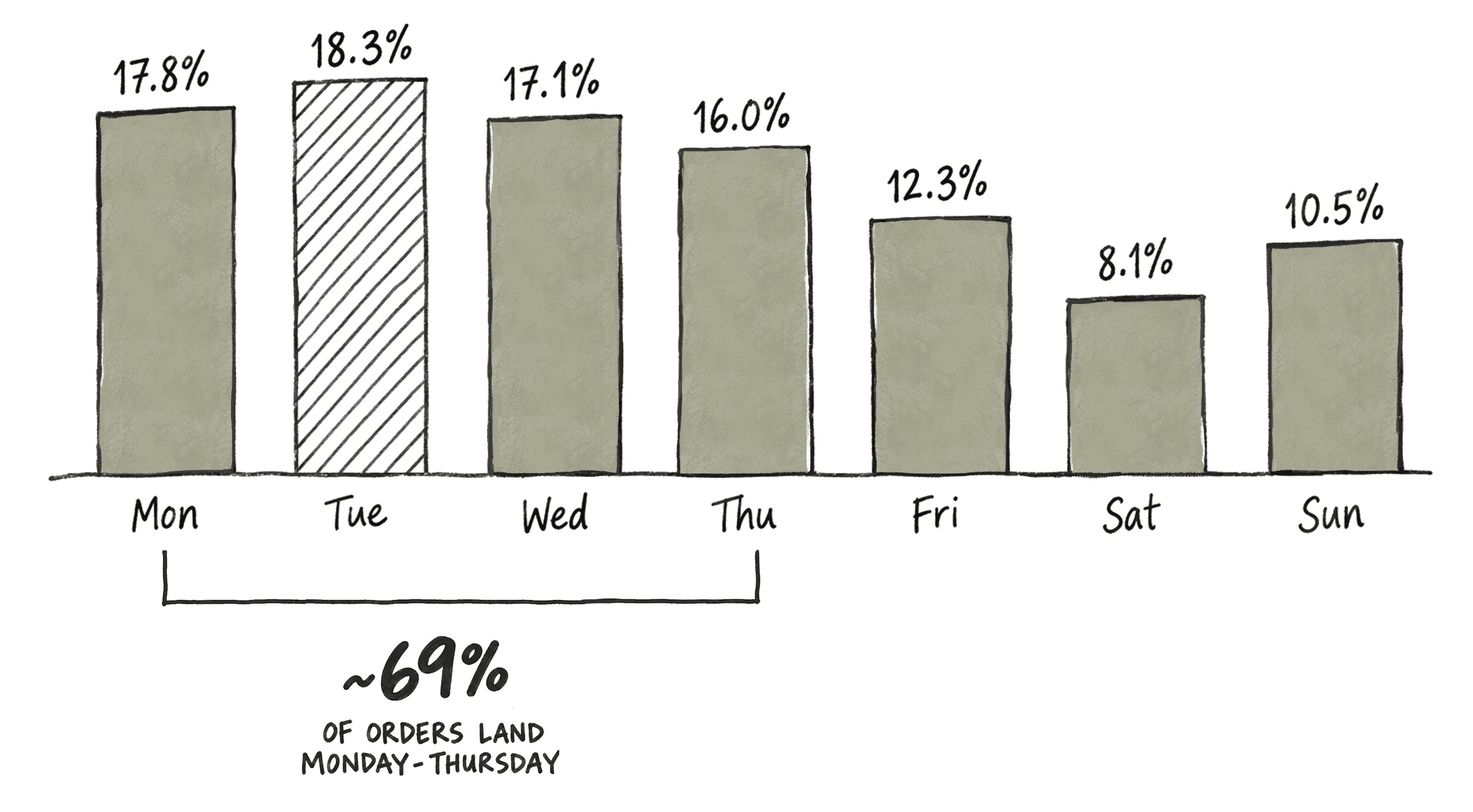
One quiet pattern spans every holiday and none: Customers buy flowers at the start of the week. Monday and Tuesday are the biggest ordering days, and nearly 7 in 10 orders are placed Monday through Thursday — flower shopping, it turns out, is a getting-organized behavior, not a weekend-browse behavior. Saturday is the quietest ordering day of the week. If you've ever queued up a bouquet from your desk on a Tuesday morning, congratulations: you are one of us!
Meet the great gifters
So, who is doing all this sending? Outside of that one week in February, the answer is overwhelmingly women. As Christina wrote in What Gift Should You Buy an Older Woman?, one of the biggest surprises of starting Farmgirl was learning that 92% of flower buyers were women — not men buying for women, but women buying for other women. Women know how great it feels to receive flowers so they want the women in their lives to feel it too. That's who sends flowers year-round: for birthdays, thank-yous, hard weeks, new houses, and no reason at all.
We wanted to know these people better. So in mid-2025, Farmgirl surveyed 557 of them — a genuinely devoted bunch: 87% had ordered four or more times, more than half had ordered seven or more — and followed up with one-on-one interviews. Allow us to introduce the great gifters:
- They love being known as great gifters. That's what the interviews told us, over and over: a bouquet isn't just a present — it's a reputation. The gift that gets a "wow" text back is the whole point. As one survey respondent put it: "My parents are wowed every time — as am I."
- The recipients become the senders. 56% first found Farmgirl through a friend's recommendation or by receiving a Farmgirl box as a gift themselves. The best flower marketing, it turns out, is a delivered bouquet.
- Quality is the whole ballgame. 66% rank flower quality and freshness first when choosing a flower service; another 20% rank design first; only 5% rank price first. Their own words for Farmgirl: high quality (73%), unique (62%), creative (59%), stylish (52%).
- Great gifters gift themselves, too. Half buy flowers as a gift to themselves — rising to 55% among the seven-plus-order crowd — and nearly half buy flowers simply as home decor. The order data agrees: about 1 in 6 of all Farmgirl orders ships to the buyer's own address. (Not every same-address order is a self-gift — plenty are one half of a household surprising the other — but the kitchen-counter bouquet is unmistakably mainstream.)
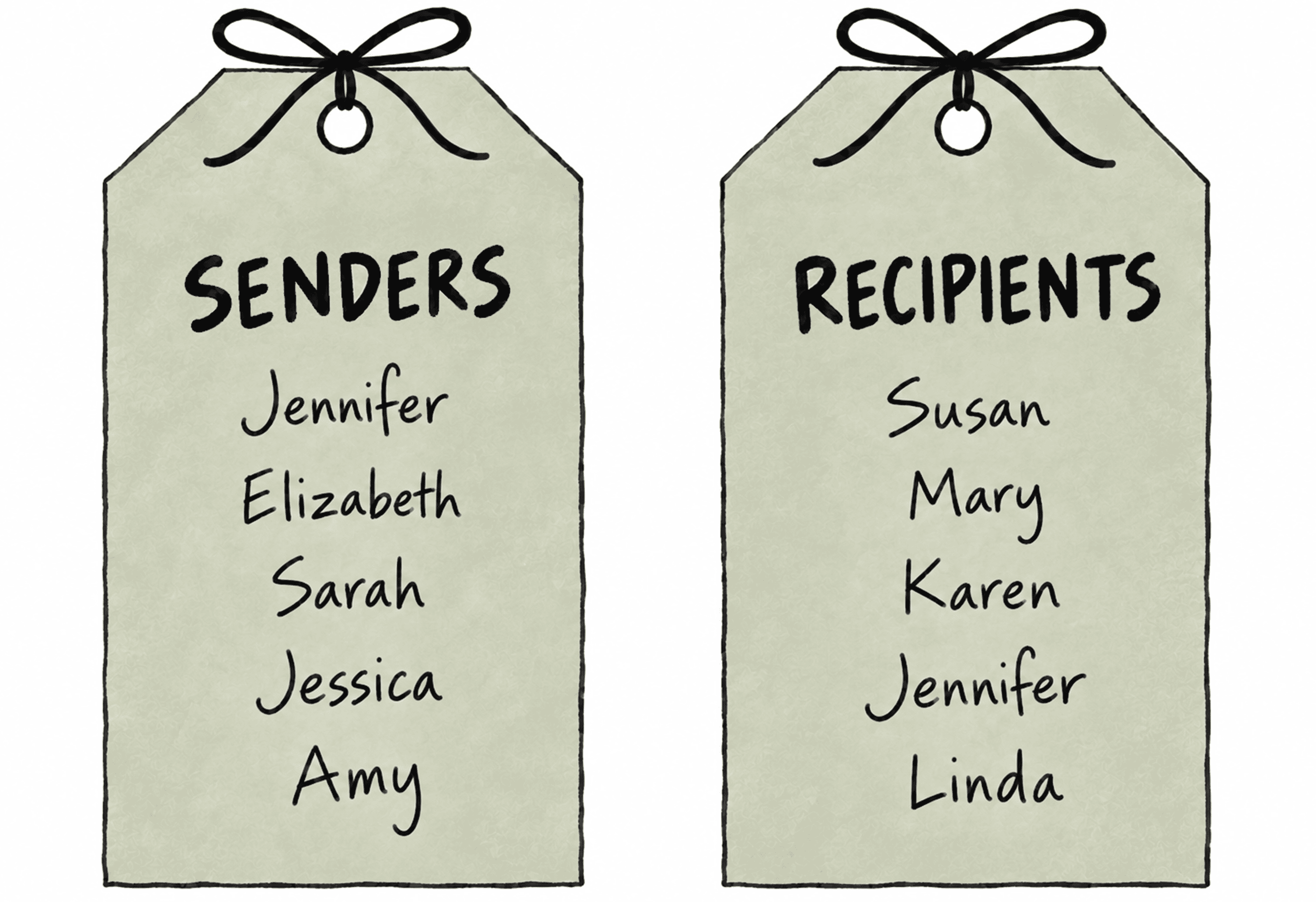
And if you want to picture the great gifters, the order data will happily paint a portrait — by first name. America's most prolific flower sender in 2026 is Jennifer, by a comfortable margin, followed by Elizabeth, Sarah, Jessica, and Amy. And the most-flowered name in America? Susan, followed by Mary, Karen, Jennifer, and Linda. Put those two lists side by side and a whole generational story appears: the Jennifers of the world are sending flowers to the Susans, Marys, and Lindas. Statistically speaking (considering the decades these names became more popular), American flower gifting is substantially powered by daughters wowing their moms — which, given everything else in this report, checks out.
New from the design team:
The trends above aren't just something Farmgirl observes — they're something the design team builds toward. Two 2026 launches came straight out of the petal-forward, seasonal shift the data shows.
The Garden Rose line, finally
In June 2026, Farmgirl Flowers launched its expanded Garden Rose line. Farmgirl had sold garden roses in smaller doses before; the 2026 line made them a full category, with more sizes, more varieties, and specialty stems like Eugenie and Juliet garden roses (including CA-grown options).
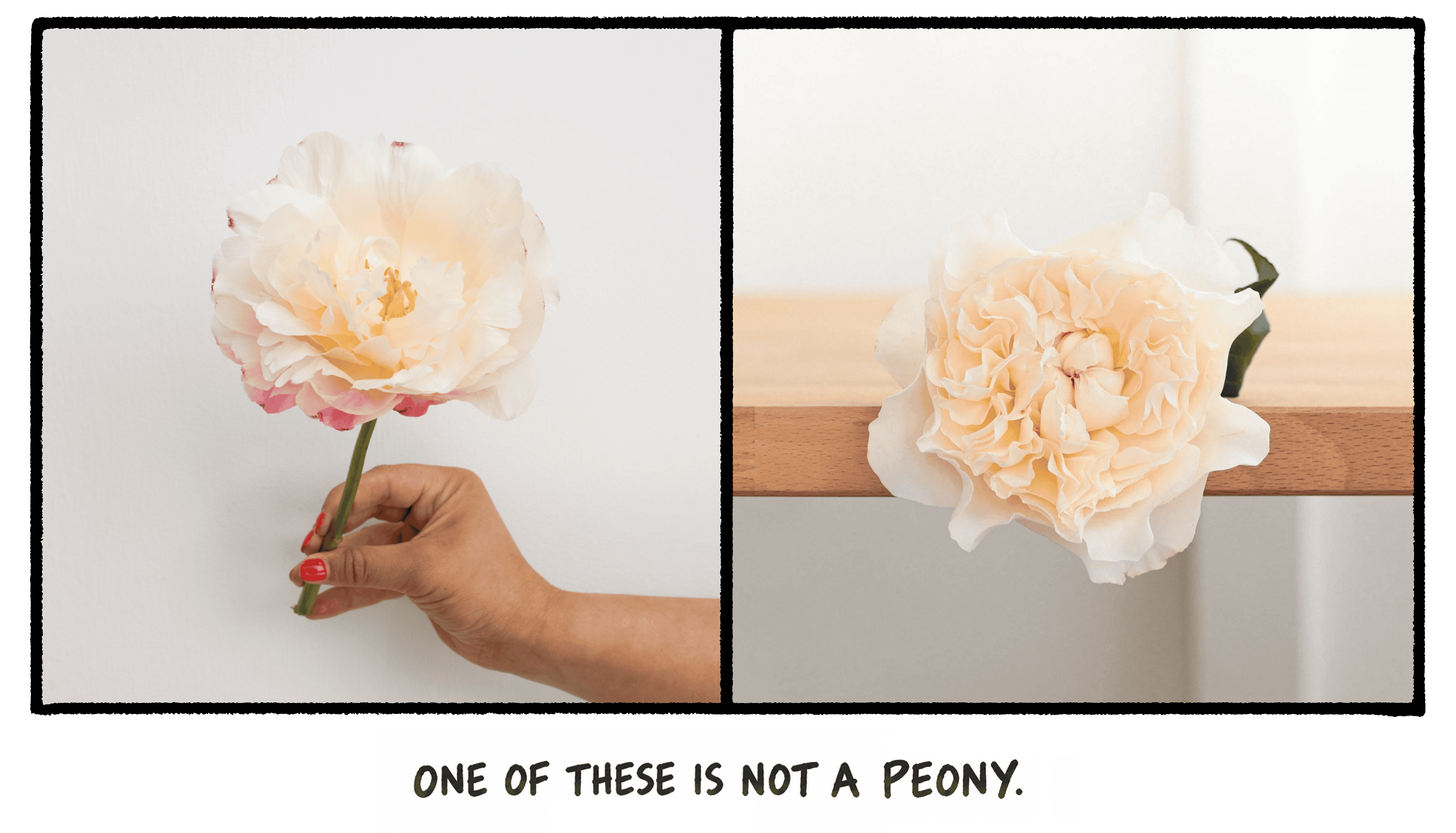
Garden roses are the rose your grandmother's garden promised and the grocery store never delivered: densely petaled, softly cupped, and — in some varieties — nearly indistinguishable from a peony. The design team said the quiet part out loud and named a bouquet after it: I Can't Believe They Aren't Peonies!, a dozen peony-like specialty garden roses (also available as a double dozen, for the truly committed). It sits alongside Cotton Candy — peachy pink garden roses — and Christina's Wedding Roses, two dozen Eugenie specialty garden roses named for the founder's own.
For the botanically curious, you can actually count the difference: standard roses often have around 20–40 petals, while garden roses commonly have 40–100+, and some especially full varieties can have well over 100. All those extra layers are what give garden roses their signature lush, ruffly, almost peony-like look.
That lineup is the 2026 trend data made shoppable. Peony product units grew 17% this year, but peony season only runs so long, garden roses bring that same lush, many-petaled, ruffled look to the rest of the calendar. We've been fans forever. Now there's a whole collection to prove it.
And the early returns agree: in the line's first summer, customers ordered more than 850 garden rose bouquets and boxes — over 400 of them from the six new designs in their first two months on the shelf.
Wreaths aren't just for December anymore
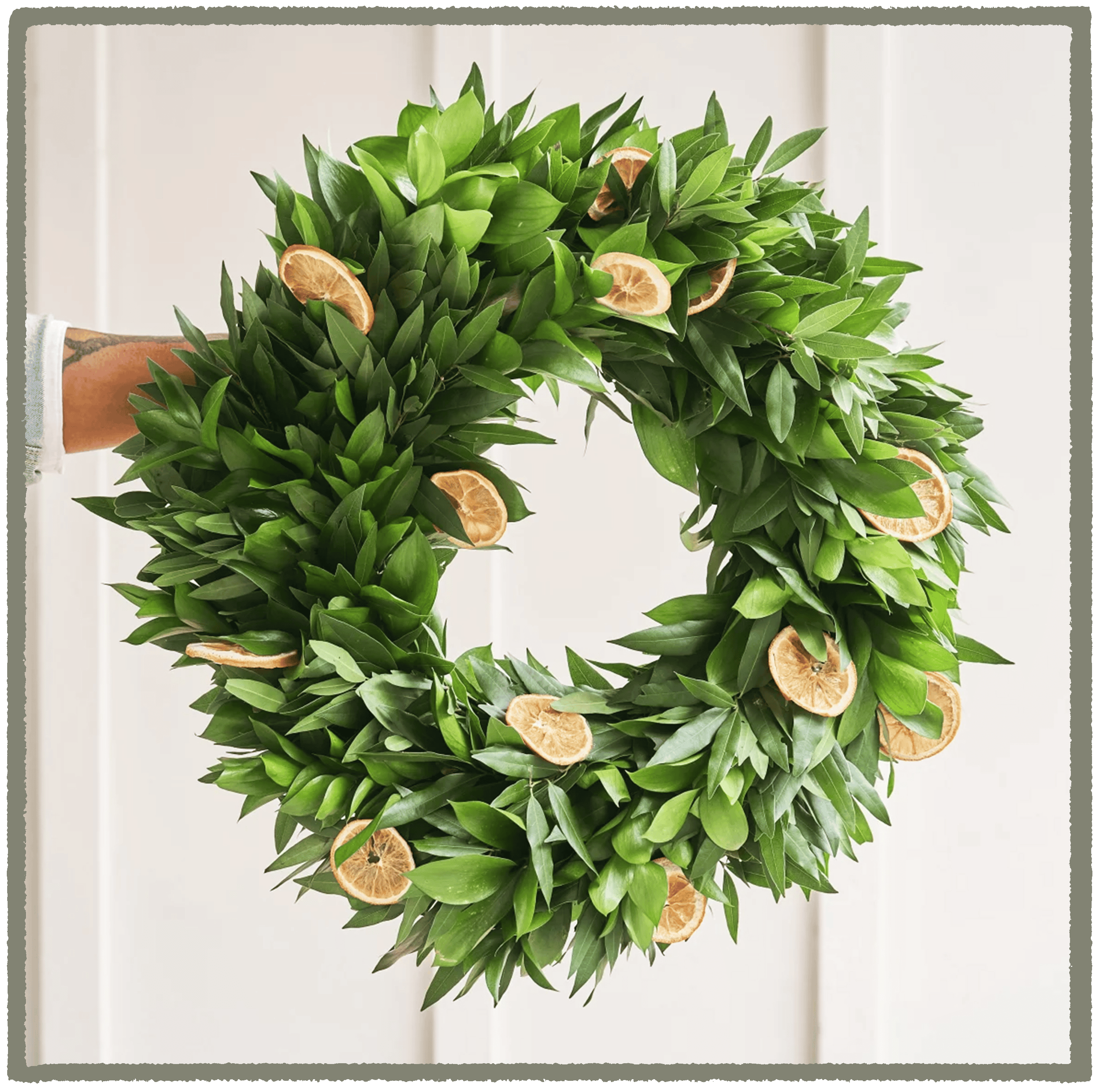
Two years ago, wreaths at Farmgirl were strictly a holiday affair — zero wreath orders outside the Christmas season. That's over. Based on Farmgirl orders, wreath units grew 81% in 2025 and in 2026 the category has already grown 17% year over year before the holiday season has even started.
Wreaths are among the most labor-intensive things Farmgirl makes — every one is built by hand, stem by stem — which is exactly why most flower companies keep them to one predictable December evergreen. Farmgirl's 2026 wreaths instead lean into the same seasonality driving the rest of this report, with ingredients you don't usually find on a front door. Think Protea, fragrant herbs, and enough eucalyptus that one of this year's best-selling wreaths is literally named Euc-phoria — fitting, given the few hundred eucalyptus seedlings going into the ground at Farmquarters (see the postcard below).
Brighter and bigger
If the first half of 2026 had a palette, it was saturated: the Lindy Hop family — one of Farmgirl's most colorful lineups — grew 38% year over year, and its supersized version, Extra Hop!, more than doubled. The same go-big instinct showed up everywhere we let it: the Maximalist outgrew its minimalist sibling at Mother's Day, and double-dozen garden roses sold nearly as fast as the single dozens. 2026's buyers want more color, and more of it.
The fastest-growing behavior in the catalog might be surrender: orders for Mystery Box and Grower's Choice designs — where you tell us the flower and our farms pick the rest — grew 82% year over year in the first half. First, buyers stopped arranging their own flowers; now a growing number of them would rather not even choose them. We have never felt more trusted, or more employed.
Flowers for your house: the Albertsons Companies partnership grows this fall
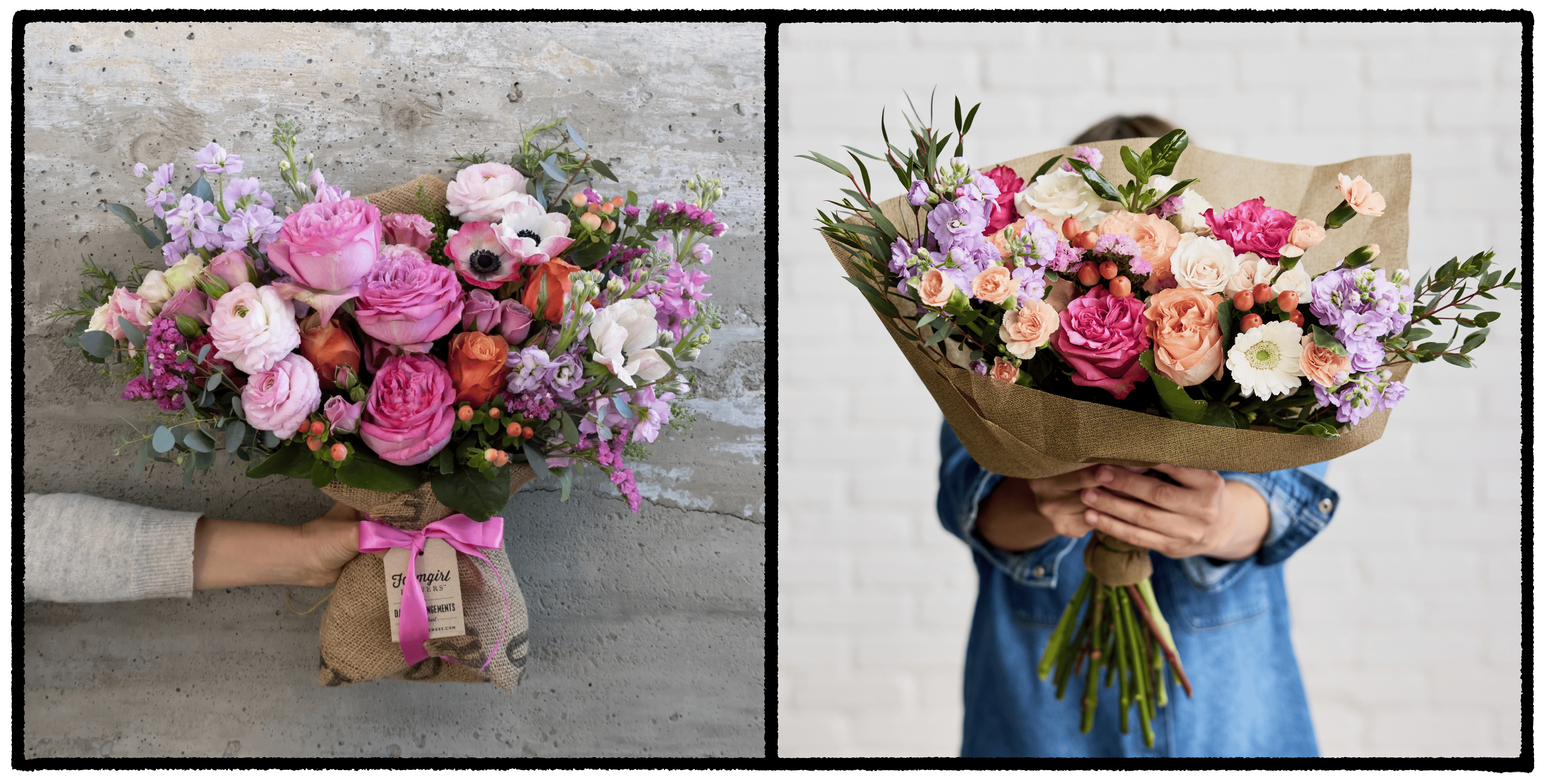
As mentioned before, half of our most loyal customers tend to buy flowers for themselves, which is exactly why this next part exists. Some flowers are a planned gesture. Others are a Tuesday impulse, a last-minute hostess gift, or a "the neighbors are coming over in an hour" situation. Farmgirl's in-store line with Albertsons Companies was designed for precisely those moments: hand-designed Farmgirl bouquets you can pick up during a grocery run you were already making.
And it's growing. As Christina shared in her July recap, the team spent part of the summer photographing a new Albertsons lineup that will be arriving in more stores this fall, along with DIY videos to help you take the flowers home, arrange them, and make them your own.
The division of labor is simple: for the quick pick-up, the unexpected gathering, the flowers-because-it's-Tuesday — find us in store. For the planned moments, the big occasions, and the bouquets that travel hundreds of miles with a card that says "love you" — we're right here, same as always.
Postcard from the Farmquarters: Designing Christmas in July
Okay — that's the flowers. Here's what we've been up to.
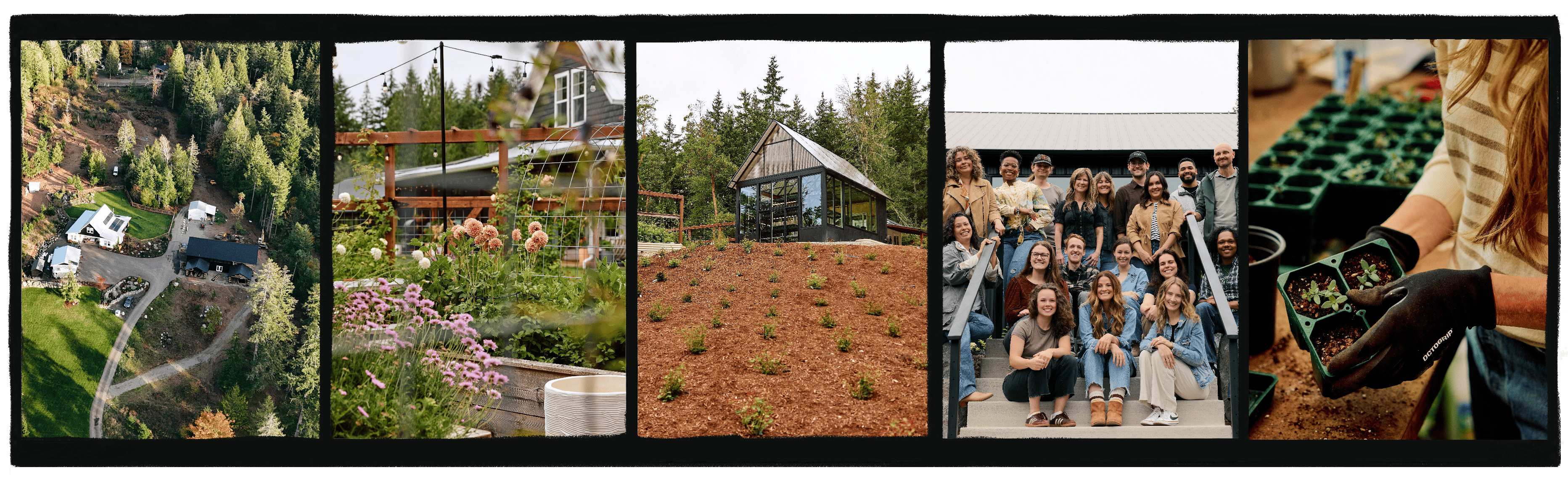
Farmquarters is Farmgirl's farm and creative hub in Gig Harbor, Washington, on a stretch of the Puget Sound with water in nearly every direction. And while everyone else was enjoying the very short, very beautiful Washington summer, the design team spent July indoors — designing Christmas. In 85-degree heat. With peppermint lattes, Christmas music, and (mercifully) a walk-in cooler. Then, because Christmas and Valentine's Day both demand an unreasonable quantity of red flowers, they designed Valentine's Day 2027 too. The flower business means living in three seasons and two calendar years at once: farm partners need to know months ahead what to put in the ground, so if we want something specific in December, we had to want it in July.
July also brought the first-ever Farmgirl Design Summit — U.S. farm and bouquet partners invited to Farmquarters for training, relationship-building, and, because we're still us, a lot of fun. They were the property's first official guests, and the whole thing went well enough that it's becoming an annual tradition. Elsewhere on the farm: a new pavilion is going up in the peony field (yes, Farmquarters has a peony field — see the first section of this report for why), and a few hundred eucalyptus trees Christina grew from seed are being planted on a slope already named Gunnii Hill — the property is being reverse-engineered to match its own name. The full July chronicle, concrete-steps enthusiasm included, is in Christina's monthly recap.
It's a fitting chapter for a company that started in 2010 when Christina Stembel — who grew up on a corn and soybean farm in Indiana — put her $49K life savings into a flower company run out of her San Francisco apartment. Sixteen years, zero dollars of outside capital, and several million hand-designed bouquets later, the farm girl has an actual farm again — peony field, eucalyptus babies, and all.
What's next: flower trends for the rest of 2026
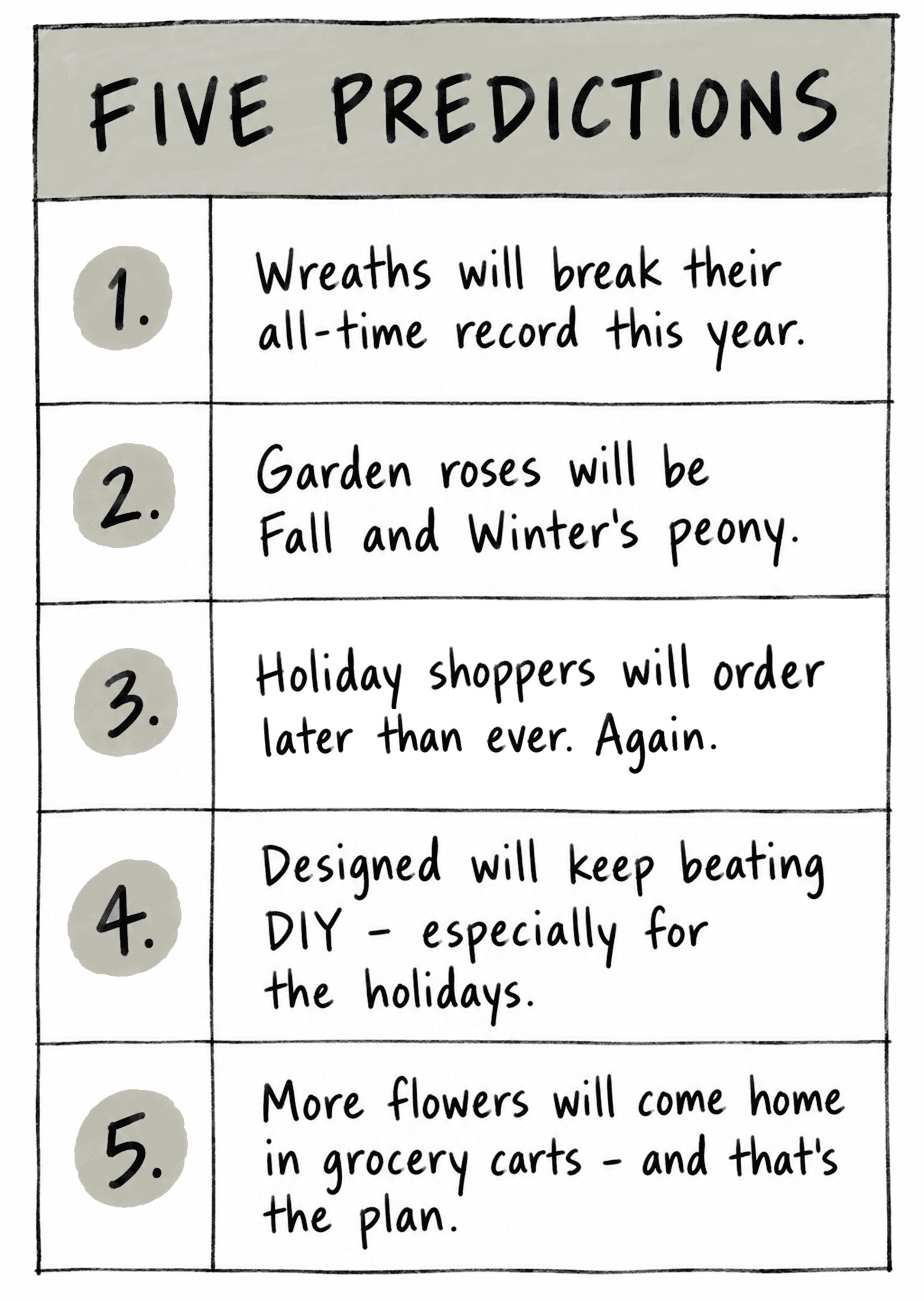
Trend predictions are usually where flower reports start guessing. We'd rather extrapolate: every call below traces directly to a number earlier in this report — and we'll grade ourselves publicly in the next one.
- Wreaths will break their all-time record this year. Customers have already ordered wreaths for the first half of the year across 10 spring and summer designs — a category that didn't exist here two years ago — putting 2026 on pace to pass 2025's full-year record. The bigger call: "wreath season" stops being a season at all.
- Garden roses will be fall and winter's peony. Peony demand grew 17% in the first half, but peony season ends when it ends. Farmgirl's expanded Garden Rose line launched in June to carry that same lush, many-petaled, ruffled look through the months peonies won't touch — expect the lookalikes, led by I Can't Believe They Aren't Peonies!, to headline the cooler half of the year.
- Holiday shoppers will order later than ever. Again. Every 2026 holiday so far shifted later: Mother's Day final-three-day orders jumped from 12.9% to 16.5% of holiday-week volume, and last-possible-day orders nearly doubled as a share. We see no evidence Thanksgiving and Christmas will reverse the trend and plenty that they'll continue it. Consider this a friendly heads-up from the data itself: peak dates genuinely sell through, so check delivery availability early with the calendar on each product page.
- Designed will keep beating DIY — especially for the holidays. Peony buyers moved from 63% designed bouquets to 75% in a single year. When the stakes are a Thanksgiving table or a Christmas mantel, we predict even more buyers hand the arranging to the professionals. Hosting is enough homework.
- More flowers will come home in grocery carts — and that's the plan. With the Farmgirl x Albertsons Companies lineup expanding to more stores this fall, the spontaneous pick-up bouquet gets easier to find — while the shipped, hand-designed, 780-miles-with-a-card gift stays right here. Given that 1 in 6 orders already ships to the buyer's own address, "flowers because it's Tuesday" is the growth story hiding in plain sight.
- And one for the road: Valentine's Day 2027 is already designed (July, walk-in cooler, peppermint lattes — see the postcard above). If this year's data repeats, a third of you will order in the final 72 hours, and only 2.5% of your recipients would pick red roses for themselves. We'll be ready either way. And yes — we'll count everything and report back.
Flower trends 2026: FAQ
What is the most popular flower of 2026?
Peonies are the most popular flower of 2026 based on Farmgirl Flowers order data, with peony product units up 17% year over year in the first half and outselling the next most popular flower nearly 4 to 1. Tulips were the fastest riser, up more than 50% over the same period.
Do people prefer designed bouquets or DIY flower boxes?
For peonies, designed bouquets are winning decisively: 75% of peony purchases at Farmgirl Flowers in the first half of 2026 were hand-designed bouquets, up from 63% a year earlier, with designed peony bouquet units growing 39% year over year. Within DIY flower boxes, peonies are still the favorite — the two best-selling boxes of 2026 are both pink peony boxes.
What flowers look like peonies?
Garden roses are the closest lookalike to peonies — densely petaled, softly cupped, and available far beyond peony season's short late-spring window. Farmgirl Flowers launched an expanded Garden Rose line in June 2026, including a bouquet of peony-like specialty garden roses named I Can't Believe They Aren't Peonies!. Ranunculus offer a similar ruffled look on a smaller scale.
What do people write on flower card messages?
"Love you" is the most common phrase on flower cards — it appears in nearly 4 in 10 card messages at Farmgirl Flowers, based on more than 150,000 messages sent in the first half of 2026. "Happy birthday" appears in about 1 in 5, "thank you" in 1 in 10, and 1 in 14 messages signs off with "xoxo." Roughly 9 in 10 flower orders include a card message.
Do women want red roses for Valentine's Day?
Mostly no — in Farmgirl Flowers' 2026 study of 400+ women, only 2.5% said they would choose red roses for themselves on Valentine's Day, though about 1 in 10 genuinely loves them. Most respondents preferred flowers that feel designed, unexpected, or personal, and only 11% wanted delivery on February 14 itself — arriving a day or two early felt more intentional.
When is peony season?
Peony season runs from roughly late April through June in the U.S., peaking in late spring — which lands squarely on Mother's Day, the biggest flower holiday of the year. That short window is part of why peonies sell out fast; outside the season, specialty garden roses offer the closest year-round substitute.
Are garden roses available year-round?
Garden roses are available across a much longer season than peonies, whose U.S. season runs only about April through June. Farmgirl Flowers' expanded Garden Rose line, launched in June 2026, was designed to carry the same lush, many-petaled look through fall and winter — check availability for any date with the calendar on each product page.
What flowers do you send for sympathy?
White and soft-toned flowers are the traditional choice for sympathy — white roses, lilies, hydrangea, and garden roses all carry the calm the moment asks for. Simple and on time matters more than big: choose an all-white or soft design, add a short, honest card message, and check delivery dates with the calendar on each product page. For help with the hardest part, see our guide on what to write in a sympathy card.
When do most people order Mother's Day flowers?
Most Mother's Day flower orders arrive in the final week before the holiday — 67.6% of Farmgirl Flowers' 2026 Mother's Day orders came in the final week, and 16.5% came in during the final three days. Ordering one to two weeks ahead gets the best selection of dates and designs; check delivery availability with the calendar on each product page.
What day do people have birthday flowers delivered?
Friday and Tuesday are the most popular delivery days for birthday flowers, each accounting for about 24% of Farmgirl Flowers' 2026 birthday deliveries. Birthdays are the biggest everyday flower occasion — "happy birthday" appears in nearly 1 in 5 of all card messages, and even in January, about 1 in 3 flower deliveries is for a birthday.
Do people buy flowers for themselves?
Yes — about 1 in 6 Farmgirl Flowers orders ships to the buyer's own address, making self-purchase one of the biggest flower "occasions" of all. Among Farmgirl's most loyal customers, half say they buy flowers as a gift to themselves. Buying fresh flowers for your own home, with no occasion attached, is fully mainstream in 2026.
How far do flower deliveries travel?
Farmgirl Flowers gifts covered a combined 94 million miles between senders and recipients in the first half of 2026, measured between sender and recipient ZIP areas. Seven in ten orders leave the sender's local area — traveling about 780 miles on average — and about half cross state lines. The busiest route in America is California to Texas, and the California–New York corridor is the biggest two-way exchange.
Are wreaths only for Christmas?
No — wreaths are becoming a year-round seasonal decoration. At Farmgirl Flowers, customers ordered wreaths at a much higher pace than last year, and this is before the 2026 holiday season even begins, and across 10 spring and summer designs — a category that didn't exist at Farmgirl two years earlier. Full-year wreath orders grew 81% in 2025.
Which states order the most flower deliveries?
California receives the most Farmgirl Flowers deliveries of any state, followed by Florida, Texas, and New York, based on first-half 2026 order data. Farmgirl Flowers ships nationwide across the lower 48 states.
What are the flower trends for fall and winter 2026?
Based on Farmgirl Flowers' first-half 2026 order data, five trends are set to define fall and winter: wreaths on pace to break their all-time record before December even arrives; garden roses taking over the peony's role in the cooler months; holiday shoppers ordering later than ever; designed bouquets continuing to win over DIY flower boxes; and more flowers coming home from the grocery store as the Albertsons Companies lineup expands this fall.
About the Data
Every order statistic in this report comes from Farmgirl Flowers' own first-party order data: orders placed between January 1 and June 30, 2026, compared with the same period in 2025. No industry estimates, no third-party panels — just what people actually bought.
Card messages. Findings are based on more than 150,000 card messages sent with orders in the first half of 2026, analyzed in aggregate by phrase frequency. No individual messages were read or reproduced — we're florists, not snoops. State-level message findings include only the 30 states with at least 800 messages in the period; smaller states were excluded so that a handful of cards couldn't skew a state's results.
Distances. Delivery mileage is measured between sender and recipient ZIP-code areas then summed across all orders in the period. The 94-million-mile figure is that total; per-order averages count only orders that left the sender's local area.
First names. Sender and recipient name findings use first names only, from gift orders only, counted in aggregate with a minimum of 200 orders per name. No individual customer information is included or identifiable.
Surveys. Two proprietary studies supplement the order data: a January 2026 study of 400+ U.S. women surveyed as flower recipients ahead of Valentine's Day, and a mid-2025 survey of 557 repeat Farmgirl customers (87% had ordered four or more times), followed by one-on-one interviews.
Rounding and comparisons. Percentages are rounded to one decimal place or expressed as natural fractions ("about 1 in 6"). All year-over-year comparisons use identical calendar windows unless a holiday's date shifted, in which case holiday weeks are compared (noted where relevant, e.g., Easter).
Journalists and researchers are welcome to cite any figure in this report with attribution and a link to Farmgirl Flowers. Questions about the data or methodology: contact us.
About Farmgirl Flowers
Farmgirl Flowers is a direct-to-consumer flower delivery company founded in 2010 by Christina Stembel, who started it with her $49,000 in savings in her San Francisco apartment and has grown it ever since without a dollar of outside capital. Every bouquet is designed in house at Farmquarters, the company's farm and creative studio in Gig Harbor, Washington, and ships nationwide across the lower 48 states — check delivery availability for any address with the calendar on each product page.
Farmgirl Flowers has been named a best flower delivery service by Forbes, Consumer Reports, People magazine, Oprah Daily’s The O List, Vogue, Good Housekeeping, Taste of Home, Martha Stewart, Elle Decor, NBC Select, The Hollywood Reporter, and CNN Underscored, among others, with individual nods for Best for Gifting (Taste of Home, 2026), Most Whimsical (Architectural Digest), and Best for Unique Bouquets (Good Housekeeping), among more. Christina appears regularly on the TODAY show, usually with an armful of flowers and a strong opinion about ranunculus.
Media inquiries and requests for the full press kit: Amanda Molina, [email protected]. More at farmgirlflowers.com/news.